
The Mark That Isn’t Real
Discover how KryoTurf™ keeps artificial turf up to 20°C cooler, helping reduce urban heat in India’s hot climate.
The Court in the Middle
Discover how KryoTurf™ keeps artificial turf up to 20°C cooler, helping reduce urban heat in India’s hot climate.
Conventional Artificial Turf Reaches 72°C in Indian Summers. KryoTurf™ Changes That
Discover how KryoTurf™ keeps artificial turf up to 20°C cooler, helping reduce urban heat in India’s hot climate.
Why Most Architectural Surfaces in India Fail Before Their Time
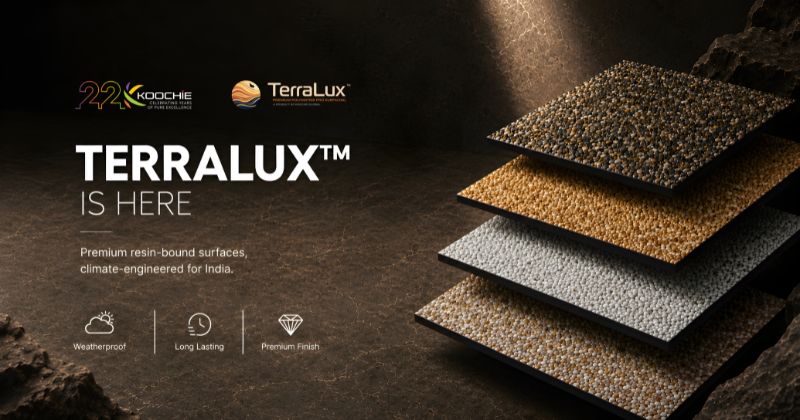
Introduction A premium development does not end at the facade. The ground it sits on, the paths between its buildings, and the surfaces connecting it to the world outside define the experience of a space as much as anything the architect draws. In India, those surfaces have a persistent problem the industry has stopped noticing because it has never had a real alternative. Intense UV radiation, extreme summer heat, and prolonged monsoon cycles place sustained stress on outdoor materials that were never engineered for these conditions. This is why resin bound surfacing India is increasingly being considered not as a decorative upgrade, but as a climate-engineered response to a long-standing specification failure in architectural and landscape surfaces. The Surface That Gets Left Behind in Summer Walk through the podium level of any premium residential development in India. Look down. The tiles are beginning to stain at the grout lines. The concrete pathway has a hairline crack running along the edge where the subbase shifted during last monsoon. The stone coping around the garden beds has turned a dull grey where the sealant has given way to UV exposure. The space looks five years older than the building it belongs to. This is not a maintenance failure. It is a specification failure. The surfaces were chosen for what they looked like on a sample board in a showroom, not for what they would face for the next twenty years in an Indian climate. And in India, what a surface faces is considerable — intense UV radiation for eight months of the year, sustained temperatures that drive ground heat well above air temperature, and monsoon cycles that test every joint, seal, and drainage specification a surface relies on, making materials engineered to withstand extreme heat and UV exposure essential rather than optional. Conventional surfaces were not designed for this. Most of them were designed for European climates and imported assumptions. The gap between what they promise on installation and what they deliver five years later is the gap that TERRALUX™ was built to close. What Resin-Bound Surfacing Actually Is Resin-bound surfacing is not a coating. It is not a sealant. It is not paint applied over an existing surface.Understanding the distinction matters, because it explains why resin-bound surfaces behave differently from everything else in this category. The process begins with natural aggregate — crushed stone, gravel, marble chip, or recycled glass, depending on the specification. That aggregate is thoroughly mixed with a clear or pigmented resin binder until every particle is completely coated. The mixture is then laid and trowelled to a smooth, consistent finish. When it cures, the result is a monolithic surface in which the aggregate is fully encapsulated within the resin matrix. Nothing is loose. Nothing is sitting on top of anything else waiting to be dislodged. The surface is permeable by design. Water passes through the matrix directly to the drainage layer below, eliminating standing water, reducing runoff, and keeping the surface dry underfoot even immediately after rain. For Indian conditions — where monsoon drainage is a live engineering concern on almost every outdoor specification — this is not a minor advantage. It removes an entire category of surface failure from the equation. The aesthetic range is wide. The aggregate choice determines the final colour and texture, which means the surface can be matched to almost any architectural palette — from warm sandstone tones for heritage contexts to cool grey aggregates for contemporary development. The cost of a surface that fails — in remediation, in reputational damage, in the visible deterioration of a space designed to impress — far exceeds the cost of specifying correctly the first time. Why Conventional Resin Systems Fail in India Resin-bound surfacing has a significant track record in European markets. The problem is that most of the formulations developed for those markets were engineered for European conditions – moderate UV exposure, temperate thermal cycling, and humidity patterns that bear little resemblance to what a surface faces in Delhi, Mumbai, or Chennai. The first failure mode is UV degradation. Resins that are not UV-stabilised yellow visibly within weeks of installation under Indian sun exposure. The discolouration is not subtle. A surface that was specified for its aesthetic quality begins to look compromised before the building it serves has been fully occupied. This is not a maintenance issue. It is a chemistry issue. The resin was not formulated to resist the UV index it is experiencing. The second failure mode is thermal stress. Indian summers drive ground temperatures significantly above air temperature. Surfaces expand under heat and contract at night. Conventional resin formulations that do not account for the thermal cycling specific to tropical climates develop stress fractures along joints and edges over time. Once the fracture appears, water infiltration accelerates the failure. The third failure mode is moisture sensitivity during installation. Resin and moisture are incompatible during curing. In India, where ambient humidity is high for much of the year and monsoon patterns can be unpredictable, conventional installation windows are narrow and the margin for error is slim. A system not designed for high-humidity installation conditions will produce clouding, bubbling, or adhesion failure — defects that are visible immediately and impossible to reverse without removing and relaying the surface. What TERRALUX™ Does Differently TERRALUX™ PolyMatrix Pro System is not a European resin system adapted for India. It is a surfacing system engineered from the specification stage for the climatic realities of the Indian subcontinent and comparable tropical environments. The resin formulation is UV-stabilised as a baseline requirement, not an optional upgrade. The chemistry accounts for the UV index that Indian installations will face across their service life. Yellowing and discolouration are addressed at the material level, not managed through post-installation maintenance. The system is formulated for thermal stability under the temperature cycling that Indian outdoor surfaces experience — high heat during the day, significant cooling at night, and sustained thermal stress across summer months. The PolyMatrix Pro formulation maintains structural integrity through this
Why Artificial Turf Gets Too Hot to Use in India. And What KryoTurf Does About It.
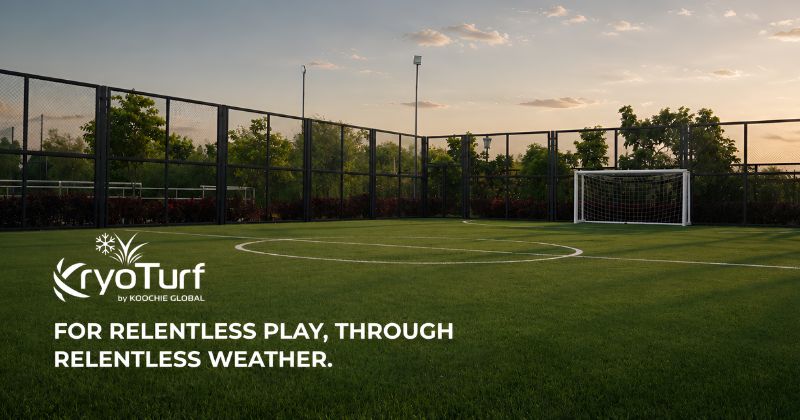
Introduction Artificial turf has transformed outdoor spaces across the country. But in Indian summers, it has a problem that nobody talks about enough. It becomes too hot to stand on. The Surface That Gets Left Behind in Summer Walk past any artificial turf installation in India between April and June. If it is midday, it is probably empty. Not because no one wants to use it. Because no one can. The surface temperature of conventional artificial turf under direct summer sun can exceed sixty degrees Celsius. That is not an exaggeration. That is what the science says, and it is what anyone who has tried to play on one of these surfaces in the afternoon already knows from experience. Artificial turf is, at its core, plastic. Polyethylene and polypropylene fibres that absorb solar radiation and retain heat in a way that natural grass, which cools itself through transpiration, simply does not. The result is a surface that looks like grass, performs like grass for most of the year, and then becomes unusable precisely when people most want to be outdoors — in the warm months of a long Indian summer. This is the problem that KryoTurf was built to solve. Why Heat Resistant Artificial Turf India Needs a Different Approach To understand what KryoTurf does, it helps to understand what makes conventional turf so prone to overheating. The answer is in the fibres themselves. Standard artificial turf fibres are made from plastic polymers that have no particular resistance to infrared radiation — the part of sunlight that carries heat. When sunlight hits the surface, those fibres absorb the infrared radiation and convert it into heat. Because plastic does not cool through evaporation the way natural grass does, that heat has nowhere to go. It builds up. On a day when the air temperature is thirty-five degrees Celsius, the surface temperature of conventional artificial turf can be nearly double that. For a housing society playground, that means children cannot use the space in the afternoon. For a sports court, it means matches are cancelled or moved indoors. For a school, it means the outdoor space that was built for daily use sits empty through the hottest part of the day, every day, for months. The investment does not disappear. But its utility does. On a day when the air temperature is thirty-five degrees Celsius, the surface of conventional artificial turf can be nearly double that. KryoTurf keeps it up to twenty degrees cooler. That is the difference between a surface that sits empty and one that stays in play. What KryoTurf Does Differently KryoTurf by Koochie Global is not a coating applied to the surface of the turf after it is manufactured. It is a change made at the point of production, inside the fibre itself. Specialized reflective pigments are infused directly into the yarn during the extrusion process — the stage at which the raw polymer becomes the turf fibre. Those pigments are engineered to reflect infrared radiation rather than absorb it. Because the pigment is inside the yarn rather than on top of it, it does not wear off, wash away, or degrade with use. It is a structural property of the fibre, not a finishing treatment. The result is a surface that reflects significantly more solar heat than conventional artificial turf, keeping the surface temperature up to twenty degrees Celsius cooler under the same conditions. That is the difference between a surface that is unusable at noon and one that remains in active play throughout the day. What Twenty Degrees Cooler Actually Means Numbers are useful. Context is better. A conventional artificial turf surface at sixty degrees Celsius cannot be used barefoot. It causes discomfort within seconds and can cause burns within minutes. A surface that is twenty degrees cooler — at forty degrees — is still warm, but it is usable. Children can play on it. Athletes can train on it. Residents can use the space without timing their visit around the angle of the sun. The barefoot test is the most direct way to understand what KryoTurf achieves. If a child can walk across the surface without discomfort in direct summer sun, the surface is doing what outdoor infrastructure is supposed to do: serving the people who use it, at the time they want to use it, without restriction. Two Applications. One Standard. KryoTurf is available in two variants, each designed for a distinct application context. KryoLandscape is designed for decorative and landscaping installations — residential gardens, terrace surfaces, playground surrounds, and communal green areas. Beyond keeping the surface cooler underfoot, KryoLandscape has a secondary thermal benefit: when installed on a terrace or roof surface, its heat-reflective properties reduce the temperature of the spaces below it as well. For buildings in high-heat urban environments, this is a meaningful reduction in cooling load. KryoSport is designed for sports court and multipurpose playing surfaces. The same reflective pigment technology is applied to a fibre specification built for the mechanical demands of daily sport use — the foot traffic, lateral movement, and surface stress that a sports court experiences over years of operation. UV-stabilised for lasting performance and built for versatile compatibility across court types and subbase specifications. Both variants carry the same engineering philosophy: a surface that performs to its full specification on the hottest day of the year, not just the days when the weather cooperates. KryoTurf is designed for housing societies, schools, and public parks. → Explore Outdoor Gym Equipment for Residential Societies The Broader Case for Cooler Surfaces in Indian Cities India’s urban heat challenge is well documented. Cities like Delhi, Ahmedabad, Chennai, and Hyderabad regularly record temperatures that make outdoor activity dangerous during peak summer hours. The infrastructure choices that cities and developers make — including surface choices — either contribute to that problem or work against it. Conventional artificial turf, precisely because it absorbs and retains heat, contributes to the urban heat island effect. It adds to the thermal load of the
What Should a School Outdoor Space Actually Look Like?
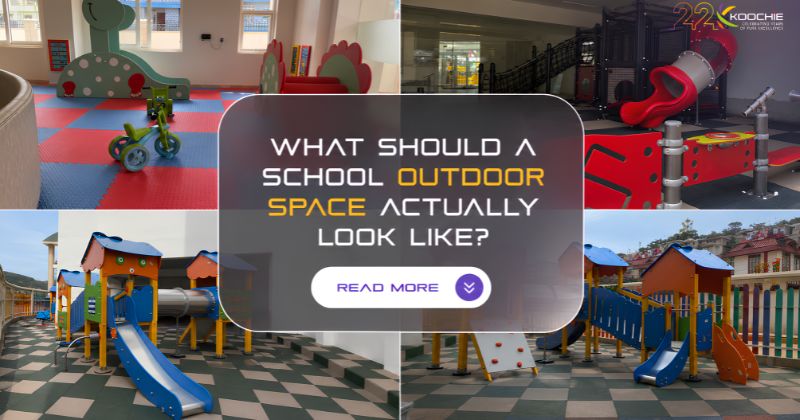
Introduction Most school leaders invest extraordinary care in what happens inside the classroom. Theoutdoor space is often the last thing on the agenda. It should be the first. The Space No One Talks About Every school has one. The patch of ground between the building and the boundary wall. It might be a sprawling field, a compact concrete yard, or a corridor of green between two blocks. Whatever form it takes, it is the space where children spend a substantial portion of their school day. And in most schools, it receives a fraction of the attention, budget, and intentionality given to the classroom it sits beside. A child who spends six hours at school will spend perhaps ninety minutes of those hours outdoors. That is not a rounding error. That is a meaningful portion of their waking day, every weekday, for the better part of a decade. The question worth asking is not whether your school has an outdoor space. Every school does. The question is whether yours is doing the work it should be doing. What the Research Says About Children and Outdoor Movement The relationship between physical movement and learning outcomes is one of the most consistently replicated findings in educational research. Children who are physically active during the school day demonstrate better concentration, improved memory retention, and lower rates of classroom disruption. This is not a theory. It is a documented pattern across decades of study spanning multiple countries and educational systems. Physical movement increases blood flow to the brain. It regulates stress hormones that interfere with concentration. It gives children who learn kinaesthetically — through physical experience rather than passive reception — the kind of engagement a desk cannot provide. For a school that cares about academic outcomes, the outdoor space is not a break from education. It is a delivery mechanism for it. The implication is direct. The quality of the outdoor space is not a luxury consideration. It is an educational investment with a measurable return. The Four Categories That Define a Complete School Outdoor Environment A well-designed school outdoor space is not a single thing. It is four distinct categories, each serving a different developmental function. 1. The Playground For children in their earliest years. Climbing frames, swings, slides, and multi-play structures that develop gross motor skills, spatial awareness, and social coordination through unstructured play. The equipment must be designed for the way children actually use it. Unpredictably. Enthusiastically. Without reading the instruction manual first. 2. The Outdoor Fitness Zone As children move through secondary school, many disengage from team sports. An outdoor fitness zone gives older students a form of physical engagement that is voluntary, self-directed, and genuinely effective. Think of it as bringing the gym outside — without the membership fee or the intimidating interior. 3. The Sports Court Multi-use courts for basketball, football, badminton, and volleyball. Surfaces that perform consistently across seasons and weather conditions. A well-built sports court is used every day by every year group for the life of the school. 4. Surface Solutions The ground underneath the equipment matters as much as the equipment above it. Impact-absorbing rubber surfaces, synthetic turf for all-weather use, and acrylic court surfaces for performance and durability. The surface is not decoration. It is safety infrastructure. Safety Certification: What It Means and Why It Is Not Optional Every school that installs outdoor equipment is making a decision with legal consequences. This is not alarmist. It is simply accurate. Public-use outdoor equipment that is not independently certified carries liability. If an incident occurs, the responsibility transfers — in whole or in part — to the institution that installed it. The school board. The management. The trust. EN1176 is the international safety standard governing children’s playground equipment. It specifies structural requirements, fall height clearances, and surface impact absorption levels. Meeting this standard requires independent laboratory testing. It cannot be self-declared. EN16630 governs outdoor fitness equipment. If your school is installing fitness stations for older students, this determines whether that equipment is structurally sound for daily public use. TÜV SUD is among the most respected independent certification bodies in the world. A TÜV SUD mark means a third-party organisation — with no commercial interest in the outcome — has tested and confirmed the product meets the required standard. For a school procurement team, this is the clearest form of assurance available. What a Compliance Record Means for Your School When a school installs certified equipment, it receives more than the equipment itself. It receives a compliance record. A transferable certification document. A structural audit trail. This is not bureaucratic paperwork. It is the legal foundation on which the school’s liability rests — or does not rest. If any question is ever raised about the safety of the outdoor space, the school has documentation that answers it definitively. The equipment was tested. It passed. Here is the record. For school governors and management boards, the compliance record is not a detail to delegate to the facilities team. It is a governance document. It belongs in the same file as the fire safety certificate and the building inspection report. The Investment That Reflects on the Institution Parents notice the outdoor space. They notice it when they tour the school before enrolling their child. They notice it when their child comes home and describes what they did at break. They notice it when the equipment is still performing well in year five — and when it is not. A school that has invested in world-class outdoor infrastructure is making a visible statement about its standards. Not through a brochure or a mission statement. Through the physical environment it has chosen to build for its students. The outdoor space is not separate from the quality of education a school delivers. It is an extension of it. And like every other aspect of a school’s environment, it reflects the institution’s values more accurately than any document the school could produce about itself. Building It Correctly the First Time Koochie
Built for Every Season. The Engineering Behind Outdoor Fitness Equipment That Lasts
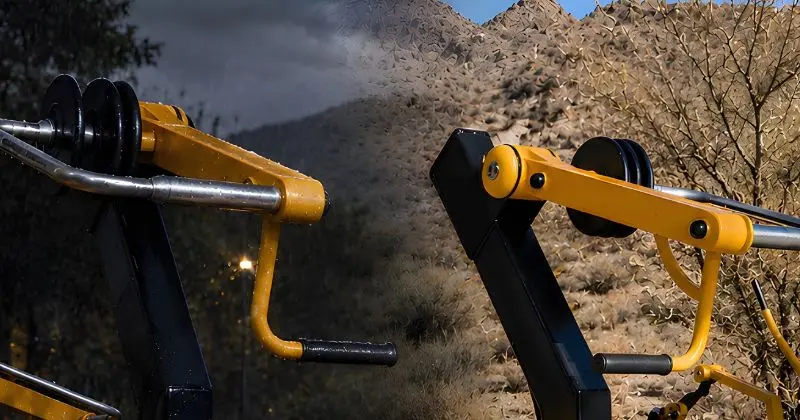
Introduction There is a question that almost never gets asked when outdoor fitness equipment is specified, purchased, and installed. It is not about the cost. It is not about the aesthetics. It is the question that only becomes relevant two or three years later, when the answer is already visible in the condition of what was installed. What was this equipment actually built to withstand? Why Weather-Resistant Outdoor Gym Equipment Matters for Long-Term Durability Outdoor fitness infrastructure occupies a uniquely demanding position among all categories of built assets. Unlike indoor gym equipment, which operates in a controlled environment, outdoor equipment faces continuous, unrelenting exposure to conditions that are impossible to replicate in a testing lab and impossible to avoid in the field. In India alone, the range of climatic stresses is extraordinary. Equipment installed in Bengaluru faces months of sustained monsoon rainfall, high humidity, and temperature variation across seasons. Coastal installations in Chennai or Mumbai contend with salt-laden air that accelerates corrosion at a rate that inland environments do not. Equipment in Rajasthan faces sustained UV exposure and heat levels that test surface coatings, seals, and structural materials simultaneously. Equipment in the hills faces freeze and thaw cycles that test every weld, every joint, and every fastener. This is not a niche engineering problem. It is the baseline reality for every piece of outdoor fitness equipment installed anywhere in the country. And it is the reason that the specification of outdoor fitness infrastructure requires a fundamentally different standard to indoor equipment. What Weather Actually Does to Equipment The mechanisms of outdoor degradation are well understood by engineers and largely invisible to procurement teams until the damage is already done. UV radiation does not simply fade colour. Over time, sustained UV exposure breaks down the polymer chains in surface coatings, causing brittleness, cracking, and eventual failure of the protective layer that sits between the structural steel and the atmosphere. Once that layer is compromised, corrosion accelerates sharply. Humidity and rainfall create the conditions for electrochemical corrosion, particularly at weld points, joints, and any location where dissimilar metals meet. Coastal salt air compounds this dramatically, introducing chloride ions that penetrate even intact surface coatings over time and initiate corrosion from within the material. Thermal cycling, the repeated expansion and contraction of materials as temperatures rise and fall, places mechanical stress on every connection point in the structure. Over years of cycling, this stress manifests as micro-fatigue in welds, loosening of fasteners, and cracking at stress concentration points. High-frequency public use adds the mechanical dimension. Equipment in a public park or residential development is used continuously, by people of varying weights, fitness levels, and movement patterns, every day. The cumulative loading on structural components far exceeds anything indoor equipment faces. The Koochie Global Engineering Response Koochie Global designs outdoor fitness infrastructure with the specific intention of performing through all of these conditions across a full operational life. This is not a marketing claim. It is reflected in the certifications the equipment carries and the engineering decisions behind every component. UV-resistant surface coatings are applied to all Koochie Global installations. These are not standard decorative coatings. They are formulated to maintain both structural and aesthetic integrity under sustained solar exposure, resisting the polymer degradation that causes conventional coatings to fail. Anti-corrosion steel treating is applied as a standard, not an upgrade. High-humidity and coastal installation environments demand a baseline level of corrosion protection that goes beyond standard powder coating. Koochie Global’s material specification reflects this. Structural engineering accounts for the mechanical demands of high-frequency public use across diverse user populations. Load-bearing components are specified and tested for the cumulative loading they will actually face over years of continuous use, not the idealised loading of a controlled laboratory test. This engineering approach is reflected in the certifications Koochie Global holds. TÜV certification represents independent verification of structural integrity and safety by one of the world’s most authoritative engineering bodies. EN16630 compliance confirms the equipment meets the European Standard designed specifically for outdoor fitness installations in public spaces. The AS 4685 standard adds the Australian benchmark for outdoor fitness equipment, which addresses climatic and mechanical performance across the full range of outdoor operating conditions. Together, these certifications are not a sales point. They are independent verification that the engineering performs as specified. What This Means for Developers and Facility Managers For the decision makers who commission outdoor fitness infrastructure, the practical implication of equipment engineering is a question of total cost over time, not purchase price. Equipment that degrades rapidly within its first three to five years generates replacement costs, safety liability, and community dissatisfaction at a rate that makes the initial cost saving irrelevant. Equipment that performs across a full ten to fifteen year operational life while remaining safe, structurally sound, and visually maintained delivers a return on investment that inferior products structurally cannot match. For residential developers, the quality of community infrastructure is a direct signal to residents about the long-term commitment of the developer to the spaces they have created. Equipment that rusts, fades, or fails within a few years of installation communicates something about the development that no marketing can undo. For municipal bodies and civic organisations, outdoor fitness infrastructure that performs across its full intended life reduces the operational burden on public budgets, eliminates the safety risks associated with degraded equipment, and maintains the quality of the public spaces that communities depend on. The Standard Worth Building To Koochie Global has been building outdoor fitness, playground, and sports infrastructure for over twenty two years. In that time, the company has installed across a range of climates, geographies, and user environments that represents one of the most comprehensive real-world testing programmes any manufacturer in this category could have. The lesson from that experience is straightforward. The outdoor environment is unforgiving. Equipment that is engineered to meet it without compromise lasts. Equipment that is not, does not. Built for the world. Built to last. Built for everyone.
Built to a Standard the World Recognises

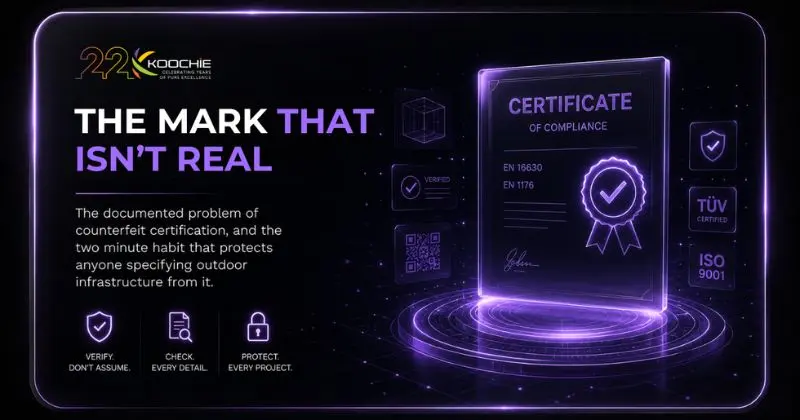
Introduction Imagine you are commissioning a playground for 500 children. Or an outdoor gym for a residential township of 2,000 families. Or a public park fitness zone that a municipality expects to stand for the next twenty years. You have one question that matters above every other. Not what does it look like. Not what does it cost. How do I know it is safe? In a market flooded with outdoor fitness and playground equipment from hundreds of manufacturers across India and the world, that question deserves a better answer than a sales pitch. It deserves proof. Independent, internationally verified, third-party proof. The kind that comes from a certification body that answers to a standard, not to the manufacturer writing the cheque. Koochie Global holds five of them. Here is what each one means, and what it says about every installation we have delivered since 2004. Why TUV Certified Outdoor Playground Equipment Matters Before we talk about standards, understand what it means when a product is not certified. It means the manufacturer assessed their own equipment, decided it was good enough, and shipped it. That is the baseline most of the market operates on. Now understand what TUV certification means. TUV is a German technical inspection and certification body with over 150 years of engineering authority. Their engineers do not take your word for anything. They arrive, they test, they measure, and they certify or they do not. For outdoor fitness equipment, TUV evaluates structural integrity, weld quality, material performance, load-bearing capacity, and whether the product is genuinely fit for continuous use by the public across seasons, weather, and years of daily wear. When Koochie Global’s fitness equipment passed TUV, it did not pass a self-assessment. It passed one of the most authoritative independent engineering reviews in the world. That is what sits behind every Titan Strength Series and Krypton Cardio Series installation we have ever delivered. The benchmark for outdoor fitness and playground infrastructure was not found. It was built. By Koochie Global. Since 2004. EN 16630. Why Outdoor Equipment Needs Its Own Standard. Here is something most people do not know. The treadmill in your gym does not need to meet the same safety standard as an outdoor fitness station installed in a public park. Indoor equipment operates in a controlled environment, maintained by staff, accessed by members. Outdoor equipment is bolted into the ground, exposed to the sun, the rain, the monsoon, and used by anyone who walks past, from a six year old to a seventy year old, with no supervision, every single day for potentially the next two decades. EN 16630 is the European standard designed specifically for this reality. It defines exactly what outdoor fitness equipment installed in public spaces must withstand: load testing, structural stability under dynamic use, corrosion resistance, weather durability, and the kind of high-frequency public wear that no indoor specification accounts for. Koochie Global’s Titan Strength Series and Krypton Cardio Series are EN 16630 certified. This is why municipal bodies, real estate developers, and institutional clients across India and internationally can specify our equipment with documented compliance in hand. Not hope. Documentation. EN 1176. The Standard That Governs Every Playground That Takes Safety Seriously. EN 1176 is to playgrounds what building codes are to architecture. It is the comprehensive European standard for playground equipment safety, and it is the most widely referenced framework in the world when professionals specify play infrastructure for schools, residential developments, public parks, and hospitality environments. EN 1176 does not deal in generalities. It covers structural performance under static and dynamic load, entrapment hazard dimensions, fall zone requirements, surface impact specifications, age-appropriate design criteria, and the integrity of every joint, weld, fastener, and moving component. It is the kind of standard that asks the hard questions before a child ever sets foot on the equipment. Every playground in the Koochie Global portfolio, from our premium modular range to our natural and bespoke collections, is EN 1176 compliant. This is not a differentiator at the top of the market. It is the minimum acceptable standard. We simply happen to be one of the very few manufacturers in India who actually hold it. EN 1177. The Certification Nobody Talks About. The One That Saves Lives. Children fall. That is not a failure of design. It is a certainty of childhood. The question EN 1177 answers is not how to prevent the fall. The question is: when the fall happens, what does the ground do? EN 1177 is the European standard for impact-attenuating surfacing beneath playground equipment. It defines critical fall height thresholds and the maximum deceleration force a compliant surface can allow on impact. In practical terms, it is the difference between a fall that results in a graze and a fall that results in a serious injury. Most equipment manufacturers do not think about this. They sell you the structure and consider their job done. Koochie Global holds EN 1177 certification because we do not separate the equipment from the environment it sits in. The structure and the surface it stands on are both our responsibility, and both are certified to the same international standard. AS 4685. Built to One of the Most Demanding Frameworks on the Planet. The Australian and New Zealand standard for playground equipment and surfacing is not a regional afterthought. AS 4685 mirrors the European EN series and in several technical areas exceeds it. It covers structural performance, age-appropriate design, hazard prevention, and impact surfacing with a level of rigour that reflects one of the most safety-conscious regulatory environments in the world. For Koochie Global, AS 4685 is not a credential we carry for the Australian market alone. It reflects our global standard of build. Our installations in Australia, Southeast Asia, the Middle East, and Europe are all specified in markets where this level of compliance is demanded. Holding AS 4685 means that when an international client asks whether our equipment meets their local standard, the answer is almost always yes. Five
The Park That Changed What Outdoor Fitness Means in India

Introduction There is a moment, early in the morning at Sankey Tank in Bengaluru, when the park belongs entirely to the people who live around it. Walkers circle the lake. Families settle onto benches. And now, at one corner of this beloved public space, something new has taken root. A row of equipment stands ready, engineered to the highest international standards, powered by nothing but the effort of whoever steps up to use it. It asks for no membership. It demands no electricity. It is simply there, built for everyone. What Defines a Modern Outdoor Fitness Park in India The installation at Sankey Tank is a complete outdoor fitness ecosystem featuring two of Koochie Global’s flagship product lines. The Krypton Cardio Series and the Titan Strength Series now stand in one of Bengaluru’s most prominent public parks, installed in partnership with Bangalore West City Corporation and inaugurated by MLA C.N. Ashwath Narayan. Olympic swimmer Srihari Nataraj was present at the unveiling, lending the occasion a sense of athletic authority that felt entirely appropriate. The Krypton Series is self-powered outdoor fitness infrastructure in the truest sense. Every machine in the series operates entirely on human kinetic energy. There is no plug point, no battery, no grid connection. The moment a person begins to pedal or move, the display activates, tracking speed, distance, time, and calories in real time. The harder the effort, the more energy the machine generates. It is a closed loop of human output and mechanical precision that has no running cost and no environmental footprint. The Titan Strength Series brings plate-loaded outdoor strength training into an open air gym setting with an engineering standard that most indoor facilities would be proud to match. TÜV certified and EN16630 compliant, these machines are built for the full spectrum of physical demands, designed to withstand continuous public use across all climates, and structured to accommodate users of every fitness level without instruction or supervision. Who It Is For The response at Sankey Tank has been immediate and telling. Within weeks of the installation going live, regular park visitors began incorporating the equipment into their routines. Older residents who had walked the same route for years found that a few minutes on the Krypton bike was achievable, manageable, and measurably beneficial. Younger users discovered a strength training option that required no gym fee and no commute. The equipment has been used by people across every age group, every fitness background, and every gender, which is precisely what it was designed for. The response at Sankey Tank has been immediate and telling. Within weeks of the installation going live, regular park visitors began incorporating the equipment into their routines. Older residents who had walked the same route for years found that a few minutes on the Krypton bike was achievable, manageable, and measurably beneficial. Younger users discovered a strength training option that required no gym fee and no commute. The equipment has been used by people across every age group, every fitness background, and every gender, which is precisely what it was designed for. The Standard Behind It What separates this installation from the category of outdoor gym equipment that has existed in Indian parks for decades is the standard to which it has been built. Koochie Global holds TÜV certification, EN16630 compliance, and IPEMA certification. These are not marketing descriptions. They are independent international verifications carried out by bodies that answer to no manufacturer. TÜV has over 150 years of engineering authority. EN16630 is the European standard built specifically for outdoor fitness equipment in permanent public installations. IPEMA certifies to internationally recognised benchmarks for public safety and construction quality. Most outdoor gym equipment installed in public parks across India holds none of these certifications. Koochie Global holds all of them, and has done so for over twenty two years of uncompromised excellence in delivering outdoor play, fitness, and sports infrastructure to public and private spaces around the world. Why This Matters Beyond Bengaluru The Sankey Tank installation is one proof point. But the question it raises is relevant to every city, every developer, every municipality, and every CSR programme in the country that is thinking about public fitness infrastructure. What standard should the spaces we build for our communities actually be held to? India has no shortage of public parks. It has a shortage of public parks that work as genuinely useful, safe, and well-engineered fitness environments. The gap between a park that simply exists and a park that actively improves the health and wellbeing of the people who use it is not a question of funding alone. It is a question of conviction. The conviction to build to a standard that holds. To choose the harder path because it is the right one. To deliver infrastructure that does not compromise on safety, sustainability, or the dignity of the people it serves. Koochie Global has been making that choice for over two decades. Sankey Tank is where Bengaluru gets to see what that choice looks like in practice. Built for the World. Built to Last. Built for Everyone.
From Parks to Performance Ecosystems. The Future of Public Fitness in India
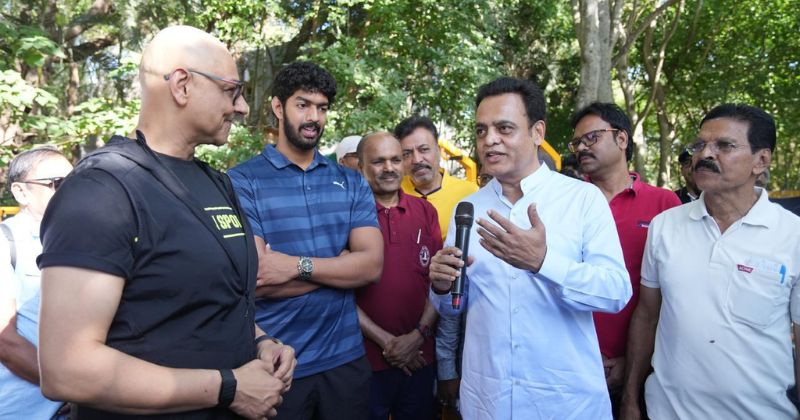
Introduction The Sankey Tank project was enabled through the efforts of Bangalore West City Corporation. It was inaugurated by C. N. Ashwath Narayan, with the facility formally unveiled by Srihari Nataraj. The initiative stands as a compelling demonstration of how governance, technology, and sport can converge seamlessly. It is not a conventional park installation. The Sankey Tank project represents a new category of infrastructure that integrates fitness with urban planning, public health, and community development. Transitioning from Installations to Self Sustaining Systems Historically, outdoor fitness installations in India have remained relatively basic, characterized by static provisions with limited adaptability and minimal technological sophistication. The Sankey Tank project transforms this landscape through the Krypton Cardio Series. This system is driven by kinetic energy generated through human activity, eliminating the need for electricity, batteries, or solar power. As a result, the infrastructure sustains itself through user engagement, establishing a regenerative ecosystem. The integrated digital consoles provide real time performance insights, including calories expended, distance covered, and workout duration. The system further adapts dynamically to user intensity, ensuring a responsive and personalized experience. This evolution redefines the user’s role, shifting from passive usage to active participation within the system. Expanding Access to High Quality Fitness Access to advanced fitness infrastructure has traditionally been limited to individuals with access to private indoor gym facilities. The Titan Strength Series addresses this gap by introducing a comprehensive strength training ecosystem within an open and publicly accessible environment. Engineered for precision, durability, and sustained usage, the system mirrors the experience of indoor gym environments while remaining accessible to all. The integration of Krypton and Titan systems creates a cohesive outdoor fitness ecosystem. Public spaces are thereby redefined as environments that support both wellness and performance, extending beyond conventional recreational use. A Framework for Urban Development The Sankey Tank project extends beyond fitness into the broader context of urbandevelopment. It demonstrates the viability of infrastructure that is energy independent, scalable, cost efficient, and aligned with public health priorities. This model holds relevance across multiple stakeholders. Landscape architects can incorporate such systems into spatial design strategies. Real estate developers can enhance project value and livability. Government authorities can deploy sustainable and low maintenance solutions. Organizations can leverage such initiatives to create meaningfulcommunity impact. National Expansion Strategy Koochie Global has outlined a phased expansion plan to extend this model across India. The first phase targets deployment across 500 parks, followed by expansion to 1000 parks in the subsequent phase. The objective is to establish a network of high quality, self powered fitness infrastructure across urban centers. This initiative aims to enhance accessibility, sustainability, and community engagement, while supporting broader priorities such as preventive healthcare and improved urban livability. Leadership Perspective and Future Outlook Roben Dass, Chairman of Koochie Global, emphasizes that public infrastructure must evolve beyond accessibility to incorporate sustainability, inclusivity, and adaptability. The Sankey Tank project exemplifies this vision by enabling communities to engage with fitness through systems that are environmentally conscious and independent ofconventional energy sources. It reflects a broader transformation in the role of public spaces, shifting from passive recreational areas to active, health focused community ecosystems. Through the integration of self powered fitness infrastructure, the project establishes a new benchmark for urban development in India. It demonstrates the potential of aligning governance, technology, and innovation to create meaningful and lasting impact. The Sankey Tank project is not solely about fitness. It represents a forward looking approach to how cities can evolve in a sustainable and inclusive manner. It stands as a significant step in India’s urban development journey, with the potential to influence future infrastructure models. The Sankey Tank project, along with the Krypton and Titan systems, illustrates how public spaces can be made more accessible, sustainable, and impactful. It highlights the role of technology and innovation in shaping communities that are healthier, more engaged, and better equipped for the future. View a quick glimpse of the event here