
Introduction
Most school leaders invest extraordinary care in what happens inside the classroom. The
outdoor space is often the last thing on the agenda. It should be the first.
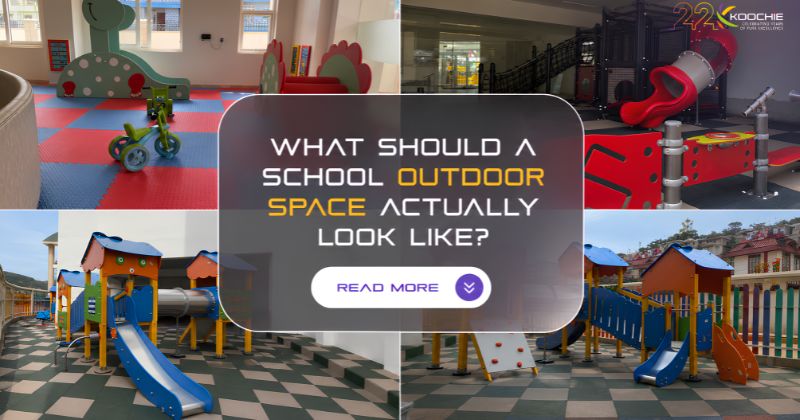
The Space No One Talks About
Every school has one.
The patch of ground between the building and the boundary wall. It might be a sprawling field, a compact concrete yard, or a corridor of green between two blocks.
Whatever form it takes, it is the space where children spend a substantial portion of their school day. And in most schools, it receives a fraction of the attention, budget, and intentionality given to the classroom it sits beside.
A child who spends six hours at school will spend perhaps ninety minutes of those hours outdoors. That is not a rounding error. That is a meaningful portion of their waking day, every weekday, for the better part of a decade.
The question worth asking is not whether your school has an outdoor space. Every school does. The question is whether yours is doing the work it should be doing.
What the Research Says About Children and Outdoor Movement
The relationship between physical movement and learning outcomes is one of the most consistently replicated findings in educational research.
Children who are physically active during the school day demonstrate better concentration, improved memory retention, and lower rates of classroom disruption. This is not a theory. It is a documented pattern across decades of study spanning multiple countries and educational systems.
Physical movement increases blood flow to the brain. It regulates stress hormones that interfere with concentration. It gives children who learn kinaesthetically — through physical experience rather than passive reception — the kind of engagement a desk cannot provide.
For a school that cares about academic outcomes, the outdoor space is not a break from education. It is a delivery mechanism for it.
The implication is direct. The quality of the outdoor space is not a luxury consideration. It is an educational investment with a measurable return.
The Four Categories That Define a Complete School Outdoor Environment
A well-designed school outdoor space is not a single thing. It is four distinct categories, each serving a different developmental function.
1. The Playground
For children in their earliest years. Climbing frames, swings, slides, and multi-play structures that develop gross motor skills, spatial awareness, and social coordination through unstructured play.
The equipment must be designed for the way children actually use it. Unpredictably. Enthusiastically. Without reading the instruction manual first.
2. The Outdoor Fitness Zone
As children move through secondary school, many disengage from team sports. An outdoor fitness zone gives older students a form of physical engagement that is voluntary, self-directed, and genuinely effective.
Think of it as bringing the gym outside — without the membership fee or the intimidating interior.
3. The Sports Court
Multi-use courts for basketball, football, badminton, and volleyball. Surfaces that perform consistently across seasons and weather conditions.
A well-built sports court is used every day by every year group for the life of the school.
4. Surface Solutions
The ground underneath the equipment matters as much as the equipment above it. Impact-absorbing rubber surfaces, synthetic turf for all-weather use, and acrylic court surfaces for performance and durability.
The surface is not decoration. It is safety infrastructure.
Safety Certification: What It Means and Why It Is Not Optional
Every school that installs outdoor equipment is making a decision with legal consequences.
This is not alarmist. It is simply accurate.
Public-use outdoor equipment that is not independently certified carries liability. If an incident occurs, the responsibility transfers — in whole or in part — to the institution that installed it. The school board. The management. The trust.
EN1176 is the international safety standard governing children’s playground equipment. It specifies structural requirements, fall height clearances, and surface impact absorption levels. Meeting this standard requires independent laboratory testing. It cannot be self-declared.
EN16630 governs outdoor fitness equipment. If your school is installing fitness stations for older students, this determines whether that equipment is structurally sound for daily public use.
TÜV SUD is among the most respected independent certification bodies in the world. A TÜV SUD mark means a third-party organisation — with no commercial interest in the outcome — has tested and confirmed the product meets the required standard. For a school procurement team, this is the clearest form of assurance available.
What a Compliance Record Means for Your School
When a school installs certified equipment, it receives more than the equipment itself.
It receives a compliance record. A transferable certification document. A structural audit trail.
This is not bureaucratic paperwork. It is the legal foundation on which the school’s liability rests — or does not rest.
If any question is ever raised about the safety of the outdoor space, the school has documentation that answers it definitively. The equipment was tested. It passed. Here is the record.
For school governors and management boards, the compliance record is not a detail to delegate to the facilities team. It is a governance document. It belongs in the same file as the fire safety certificate and the building inspection report.
The Investment That Reflects on the Institution
Parents notice the outdoor space. They notice it when they tour the school before enrolling their child. They notice it when their child comes home and describes what they did at break. They notice it when the equipment is still performing well in year five — and when it is not.
A school that has invested in world-class outdoor infrastructure is making a visible statement about its standards. Not through a brochure or a mission statement. Through the physical environment it has chosen to build for its students.
The outdoor space is not separate from the quality of education a school delivers. It is an extension of it. And like every other aspect of a school’s environment, it reflects the institution’s values more accurately than any document the school could produce about itself.
Building It Correctly the First Time
Koochie Global designs and installs outdoor playground equipment, outdoor fitness zones, sports infrastructure, and surface solutions for school campuses across multiple countries. Every installation is TÜV SUD certified, EN1176 and EN16630 compliant, and delivered with a full compliance handover pack.
There is no lower-specification product range for school environments. School environments do not call for a lower standard. They call for exactly the same one, applied to users who deserve it the most.
The outdoor space your school builds today will be used by children every day for the next twenty years. Build it correctly the first time.