
Introduction
22M+ sq m
72°C
20°C
Introduction
India’s urban heat problem is a climate story. But it is also a specification story. Every surface chosen for a park, playground, housing society, or school campus is either adding to the thermal burden of the city around it — or working against it. For landscape architects, developers, and civic planners, that specification decision matters far more than the industry has acknowledged.
And right now, one of the fastest-expanding surface choices across India is making that decision badly.
The summer India cannot ignore
In 2026, India is home to 98 of the world’s 100 hottest cities. Temperatures have crossed 45°C across northern, central, and eastern India. The India Meteorological Department has issued repeated heat advisories. Hospitals are reporting rising cases of heatstroke. Children, the elderly, and outdoor workers are being advised to stay indoors during peak hours.
This is not only a climate story — it is a built-environment story. Research from the Indian Institute of Science found that Bengaluru’s built-up area rose from just 8% in 1973 to 87.6% in 2025. The Council on Energy, Environment and Water found that nearly 70% of Indian districts recorded at least five additional very warm nights every summer between 2012 and 2022.
Nights are heating up faster than days. A city that cannot release its stored heat after dark is a city accumulating a thermal deficit that its residents pay for in health, energy costs, and quality of life.
The gap between how hot Indian cities are and how hot the land around them is forms what scientists call the urban heat island effect. It is driven significantly by the materials cities are built from — concrete, asphalt, glass, and metal absorbing solar radiation during the day and releasing it slowly through the night.
And increasingly, across thousands of parks, housing societies, school campuses, and sports courts across India, one material in particular is expanding this problem at pace: conventional artificial turf.
The artificial turf problem: scale, heat, and what the data actually shows
India’s artificial turf market was valued at approximately ₹2,800 crore (USD 337 million) in 2024, according to IMARC Group. It is projected to reach ₹4,200 crore by 2033, making India the fastest-growing artificial turf market in the Asia-Pacific region.
At market-average installation rates, this translates to over 22 million square metres of new artificial turf installed every year — an area larger than the combined footprint of several Indian city centres, added to urban environments annually.
The cumulative installed base across India today runs into hundreds of millions of square metres, spread across football courts, residential podium gardens, school playgrounds, terrace gardens, urban parks, and commercial landscapes.
Every one of those square metres is making a decision about heat. And in a country where urban temperatures already exceed the limits of safe outdoor activity, conventional artificial turf is making that decision in the wrong direction.
What the heat data actually shows
Here is the core problem: artificial turf has no evaporative cooling mechanism. Natural grass cools itself by releasing moisture through transpiration. Artificial turf has no comparable process. Surface evaporation from conventional turf is close to zero. Heat absorbed during the day has nowhere to go except outward — into the surrounding air, through the night.
The data across tropical and subtropical climates directly comparable to India’s is consistent. A peer-reviewed field study conducted in Hong Kong — a humid-tropical environment at a latitude comparable to Kolkata and Chennai — found that conventional artificial turf reached surface temperatures of 72.4°C on sunny days while adjacent natural grass recorded 36.6°C. The temperature differential on the same day, in the same conditions, was nearly 36 degrees.
Research published in Building and Environment found that the average hourly surface temperature of artificial turf under summer conditions reached 71.6°C. A field study across 51 consecutive summer days in Melbourne found that conventional turf maintained a daytime mean surface temperature of 49.9°C while irrigated natural grass stayed at 29.9°C. The Melbourne study found that artificial turf consistently exceeded the 48°C skin burn threshold for almost four hours of every single day measured.
India’s climate is more demanding than Hong Kong’s or Melbourne’s. Indian cities regularly record air temperatures of 40°C to 48°C in peak summer. The skin burn threshold that Melbourne turf exceeded for four hours a day is crossed by Indian conventional turf at the start of the morning and held through the afternoon.
And it doesn’t end at the surface. A 2024 study published in Frontiers in Sustainable Cities confirmed that conventional artificial turf showed consistently higher temperatures than natural grass both during the day and through the night — steadily heating the air around and above it.
The evidence is consistent across studies and geographies. The heat contribution of conventional artificial turf is a product of how it is engineered — not an unavoidable property of the material. Which means it can be engineered differently.
KryoTurf™: engineered to solve the heat problem at its source
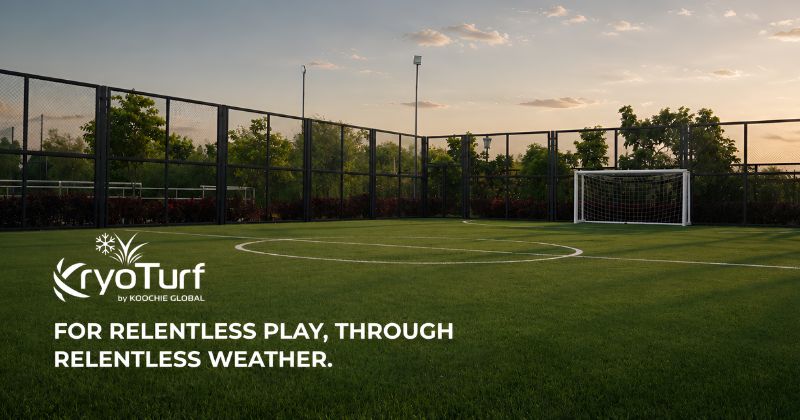
KryoTurf™ by Koochie Global is the only artificial turf system in India engineered with reflective pigments infused at the fibre level — delivering surfaces up to 20°C cooler than conventional turf under the same conditions.
The distinction matters: the pigment is built into the yarn during the extrusion process, not applied as a surface coating. It does not degrade with use or UV exposure over time. It is a structural property of the material — present from day one through the full service life of the installation.
Those pigments are engineered to reflect infrared radiation rather than absorb it. Set against the Hong Kong tropical study data — where conventional turf reached 72.4°C while adjacent grass recorded 36.6°C — a 20°C reduction from KryoTurf™ brings the surface temperature meaningfully closer to what natural grass achieves.
A European field study measuring cooling interventions found that on days where air temperature was 30°C, conventional artificial turf reached 62.5°C. An engineered cooling system brought that same surface to 37°C — within 2°C of natural grass. Dutch research cited in global market analysis demonstrated temperature reductions of up to 25.5°C through surface engineering interventions.
The principle is proven. KryoTurf™ applies it at the point of manufacture, for Indian conditions, at Indian scale.
For a landscape architect designing the outdoor environment of a residential development with 3,000 square metres of turf surface, a 20°C surface temperature reduction is not a specification footnote. Across that area, it represents a measurable reduction in the radiant heat load affecting everyone using the space, the air temperature in the surrounding courtyard, and potentially the cooling burden of the floors immediately above and below. The specification decision compounds across scale.
The playground, sports court, or podium garden specified with KryoTurf™ is not just cooler for the person using it. It is contributing substantially less heat to the air and the environment around it.
TERRALUX™ and the hardscape side of the equation
Artificial turf addresses the soft landscape layer of India’s urban heat problem. The hardscape layer — driveways, pedestrian walkways, podium decks, pool surrounds, and communal paved areas — presents an equivalent specification opportunity.
Conventional concrete and asphalt are dense and impermeable. They absorb solar radiation during the day, trap it in their thermal mass, and release it slowly after dark. This is the same mechanism at work as conventional turf — and it carries the same consequences.
TERRALUX™ PolyMatrix Pro System, available through Koochie Global’s Architectural Surfaces Division, is a resin-bound surfacing system that is permeable by design. Water passes through the surface directly to the drainage layer below, partially restoring the evaporative function that impermeable surfaces eliminate entirely.
A permeable surface does not trap moisture at the surface level. It reduces the radiant thermal load it contributes to the local environment — and when installed on terrace or rooftop surfaces, its heat-reflective properties measurably reduce the temperature of the spaces beneath it. For residential developments and commercial buildings in Indian cities, this is a thermal benefit that extends from the outdoor surface specification into the building’s internal cooling performance.
TERRALUX™ is UV-stabilised and climate-engineered specifically for Indian and tropical conditions — addressing the yellowing, cracking, and thermal stress failures that affect conventional resin and hardscape systems imported from temperate climates. For landscape architects and developers specifying outdoor areas of premium developments, it delivers on both aesthetic ambition and thermal responsibility.
The specification that cities need to make now
India’s artificial turf market will exceed ₹4,200 crore by 2033. At current installation rates, India adds over 22 million square metres of new artificial surface annually. If that surface continues to be conventional turf, India is adding the thermal equivalent of a significant new heat source to its cities every year — in a country that is already home to 98 of the world’s 100 hottest urban environments.
The landscape architect who specifies KryoTurf™ instead of conventional turf for a single development is not solving India’s urban heat crisis. But they are making a measurable, documented difference to the thermal environment of that development and to the air temperature of the streets around it. At the scale of an entire city’s annual specification decisions, those differences are not incremental. They are consequential.
The right materials are available. The science is documented. The products — engineered specifically for the conditions India presents — are ready to specify.
The urban heat crisis will not be solved one surface at a time. But it will not be solved without every surface making the right decision.