
What Koochie Global Believes a Playground Is Really For
Koochie Global has spent two decades building playgrounds across thousands of properties, and the same four people keep showing up on the same patch of ground. A grandparent on duty since morning. The child care helper looking after the household’s youngest. A parent stepping out between video calls. A teenager who has outgrown every piece of equipment but not the habit of showing up anyway. The children are why any of them are there. They are rarely the only reason the adults stay.
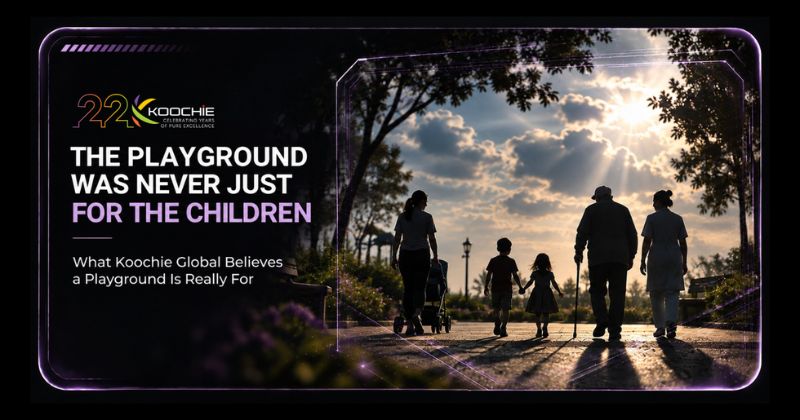
Four People Who Would Otherwise Never Meet
Most of the day, these four are nowhere near each other. The grandparent is upstairs with the television on low. The child care helper is a few floors down, getting the toddler fed and down for a nap. The parent is on a call that could run five more minutes or forty. The teenager is in a room with the door shut. A building can hold all of them for years without any two of them properly talking.
What changes in the late afternoon isn’t that anybody decides to make time for the others. It’s that a playground exists at all, and a playground happens to be one of the only places in a gated complex where showing up doesn’t require choosing anything, or signing anything, or paying a fee. A clubhouse has a booking sheet. A gym has a membership. The ground under a slide has neither, so everyone’s separate schedule ends up clearing at roughly the same hour, for roughly the same reason, without anyone planning it that way.
What Actually Happens While the Kids Play
Nobody arrives at a playground looking to make a friend. Everyone arrives because a child asked, or because somebody has to keep an eye on one for the next half hour.
Then, almost every time, something else happens alongside the watching. Two parents compare notes on which paediatrician is actually taking new patients. A grandparent learns which vegetable vendor still delivers on Sundays. A child care helper and a parent end up in a longer conversation than either expected, about nothing urgent at all, the heat, school fees, whether the new watchman is any good. Somebody’s tuition recommendation gets passed along. Somebody’s number gets added to a group that will outlast the summer.
Koochie Global never planned for any of this. The company’s job stops at the equipment and the ground it sits on. But enough site visits over enough years have turned up the same two or three people still standing near the gate long after the children have wandered off, mid conversation, in no hurry to leave, that it’s become part of how the company thinks about what a playground is actually for.
What Twenty Years on Both Ends Actually Means
A playground and a sports court look, on paper, like they belong to different parts of the same company, which in the narrowest sense they do. But the discipline underneath both is closer to identical than the finished surfaces suggest, tested against international standards for much the same reason in either case, because a body moving quickly across a surface, whether it belongs to a four year old landing off a slide or a sixteen year old landing off a rebound, has to be protected by ground engineered for that impact rather than merely poured to look finished.
Koochie Global has held EN 1176 and EN 1177, the certifications that govern playground equipment and the ground beneath it, since long before most of the children currently walking onto its sports courts were born. The company did not need to build a second standard of rigor to follow a child into competitive sport. It had already been building toward that same rigor, at the other end of the same body of work, for years before any of this term’s players arrived.
One of the more literal places that rigor shows up is the turf itself. Artificial turf fibre is plastic, polyethylene and polypropylene, and plastic has no equivalent to what grass does when it gets hot. Grass cools itself through transpiration. Plastic simply holds the heat it absorbs. A peer reviewed field study in Hong Kong recorded conventional turf at 72.4 degrees Celsius on a sunny day, with natural grass alongside it at 36.6. In Melbourne, across 51 consecutive summer days, conventional turf sat above the 48 degree skin burn threshold for close to four hours of every day measured.
None of that mattered very much while a child’s total time on a hot surface was the length of a playground visit. It matters considerably more once the same child is running drills on that kind of surface for an hour, several afternoons a week. Koochie Global’s answer is called KryoTurfTM. Chilltech reflective pigment is infused into the yarn at the extrusion stage, when the raw polymer is still becoming turf, rather than sprayed on afterward as a coating that would eventually wear off. The fibre reflects infrared instead of absorbing it, and the surface runs up to 20 degrees Celsius cooler under the same sun that would otherwise put it well past the point most parents would think twice about.
“The ground itself was quietly doing something no clubhouse or gym on the same property could do.”
Why It Still Matters
Adult friendships get harder to make with every year past school, harder still once a relocation or a new baby resets the map of who is actually nearby. A working parent’s day can pass entirely indoors, between a desk and a kitchen and a screen, without a single unplanned conversation in it. A grandparent who has moved cities to help raise a grandchild often knows almost nobody in the building at all.
Koochie Global does not claim a playground fixes that. But showing up regularly, at roughly the same time, near roughly the same people, is still one of the few reliable ways left to learn somebody’s name, and a playground is one of a shrinking number of places where that kind of unplanned showing up still happens by default.
What Koochie Global Has Always Believed
Koochie Global builds play areas and play towns. It does not build the conversations that happen inside them, and has never pretended to. But two decades of building the places where children play has also meant two decades of watching what happens around the edges of that play: who sits down and stays, who keeps talking past the first call to come home for dinner, who is still there twenty minutes after their own child has wandered off to something else.
That is the part of a playground Koochie Global has come to think matters most, not how many children a space can hold at once, but how long the adults around them choose to stay once they have stopped watching the clock.
The brochures tend to photograph the slide, because that is the part a photograph can capture. The conversation next to it, the borrowed vegetable vendor’s number, the friendship that outlasts the summer, rarely makes it into any documentation at all. It may be the part of the work that has mattered most.