
How Koochie Global Closes the Gap Between Three Rooms
A playground specification is complete when it leaves the designer’s desk. By the time it reaches a contractor, it has usually passed through a school facilities committee, an RWA managing committee and a budget committee, each of which is entitled to change it, each of which is right about the thing it is looking at, and none of which is looking at what the other two already removed. Koochie Global’s answer starts at the point the specification is written, not the point it fails.
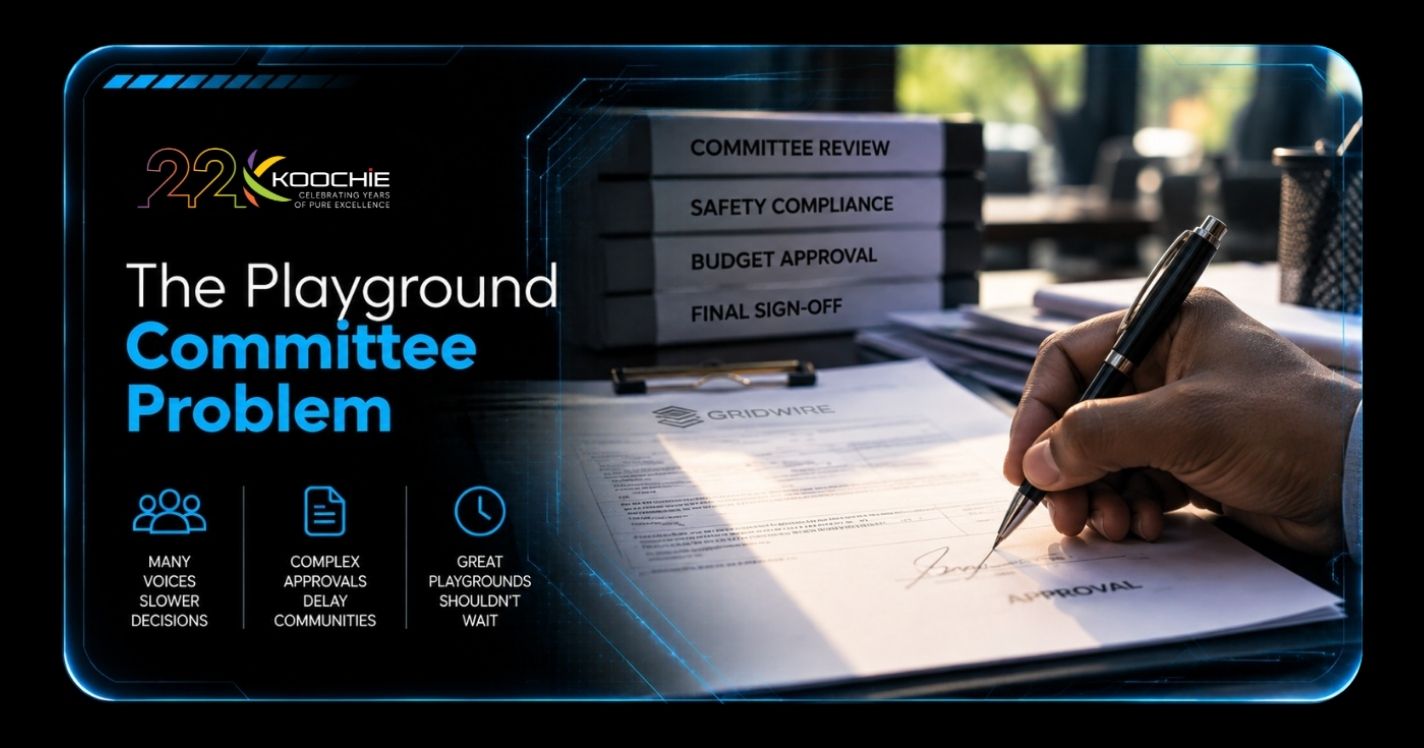
The Document Koochie Global Leaves Complete
A playground specification leaves Koochie Global’s desk as a precise document. Surfacing depth is calculated per station against the critical fall height of the equipment above it. Certification standards are named, EN 1176 for the equipment and EN 1177 for the surfacing beneath it. Base preparation, UV stabilisation, drainage fall and edge detail are all written down, because each one was a decision somebody made for a reason.
What arrives at the contractor stage months later is usually still called the same document. It still references EN 1176 and EN 1177 on the cover page. Very little else about it has stayed the same, and the part that changed is rarely the part anyone remembers approving.
What is rarely written down anywhere is why each figure is what it is, and why is the part of a specification that survives the fewest meetings. Koochie Global treats that why as part of the deliverable, not as background the designer keeps to themselves, which is where the rest of this document starts.
Three Rooms, One Document
Koochie Global has traced the same pattern across enough playgrounds to stop calling it bad luck.
The specification does not fail in one meeting. It passes through three, and each one is doing its actual job correctly.
A technical committee, inside the school or on the RWA’s own subcommittee, reviews it for safety and compliance. This is where critical fall heights get checked against equipment, and where the document is, at this stage, still accurate. What this room needs is the calculation, not only the conclusion: which standard applies, what depth follows from it, and why that depth changes from one station to the next. Koochie Global hands this committee the calculation itself, not a number lifted out of it, so a technical reviewer returning to the document months later can still see how the figure was reached rather than simply trusting that it was.
A managing or general body committee reviews it next, for the questions its members are actually positioned to answer. What will this look like. What will residents or parents say about it. Which colours, which brand of slide, which corner of the site. These are legitimate questions, and this committee is right to ask them. It is also the room where a well specified playground and a good looking one can be the same document, provided the choices on the table, colour, layout, equipment mix, were already engineered by Koochie Global to the same safety baseline before they reached it. Nobody in that room should have to understand EN 1177 to choose confidently between two designs that both already meet it.
A budget or finance committee reviews it last, with the authority to request value engineering against a number that was fixed before the technical review ever happened. This committee is also doing its job. It has a figure to hit and a document with line items in it, and reducing a line item is precisely what it exists to do. What this room needs, and rarely gets, is the difference between a line that is engineering and a line that is preference. Koochie Global marks that difference on the document itself, at the point it leaves design, so a request to bring the budget down by eight percent has somewhere safe to land before it lands on surfacing depth by default.
Nobody in any of the three rooms sees the document the way the designer who wrote it did. Nobody in the third room was in the first. World class design, the right equipment and a budget that holds are not three outcomes competing for the same document. They are three different rooms asking three different, legitimate questions, and the specification only survives all three if each room is answered in the language it actually uses, which is the translation Koochie Global writes into the document before any of the three meetings happen.
What Gets Cut, and What Koochie Global Marks First
Surfacing depth is the clearest example, because it looks like a single number and is actually several. A critical fall height calculation produces a different required depth under a three metre platform than under a balance beam forty centimetres off the ground. The specification reflects that, station by station.
A budget committee working from a cost sheet does not usually see it station by station. It sees a single surfacing line item and asks whether the figure can come down uniformly across the site. A uniform reduction is an easy number to approve and an easy number to defend, and it is invisible on the day of handover, because the surfacing still looks like surfacing under every piece of equipment. It only becomes visible under the tallest structure on site, at the exact moment it is tested against the standard it was originally calculated to meet.
UV stabilisation fails the same way for a different reason. A stabilised and an unstabilised compound look identical in a sample and cost different amounts on the invoice. Removing the stabiliser is a cut that shows nothing wrong for months, which makes it one of the easiest lines in the whole document to take out, and one of the hardest to notice was ever taken.
Equipment substitution is the same failure wearing a different name. A specified unit swapped for a visually similar one, to trim supply cost, can look identical in a render while carrying a different EN 1176 test report, or none at all. All three cuts are the kind a budget committee can make and never learn it made, unless it was already told, before the cost sheet ever reached the table, exactly which lines Koochie Global has marked as fixed.
“A specification does not fail in one decision. It fails in the gap between three correct ones.”
Nobody in the Room Is Negligent
This is the part worth being precise about, because the instinct is to look for whoever made the bad call. Usually nobody did.
The facilities committee member who signed off the technical review is not negligent for not attending the budget meeting three months later. The budget committee member who requested an eight percent reduction in the surfacing line is not negligent for not knowing that eight percent falls unevenly across a site with stations of different heights. Both decisions are reasonable, made by reasonable people, inside the authority each committee actually has.
The gap is not a people problem, which is exactly why staffing it with more good intentions has never closed it. Koochie Global closes it a different way, by making sure what travels between the rooms is already complete: the calculation as well as the conclusion, the marked lines as well as the free ones. What is missing, in a specification without that step, is not competence in any one room. It is somebody who understood what the original numbers were protecting against, still in the loop before the document becomes a purchase order.
The Step Koochie Global Adds Back
The fix is not another committee. It is a single re-approval, narrower than any of the three meetings that came before it, and limited to one question. Does the document that is about to be procured still say what the original technical reviewer signed off, on the specific lines that protect against injury rather than the lines that affect appearance or cost alone.
That question is cheap to answer when it is asked deliberately and expensive to answer by accident, which is what a post installation test becomes when it turns up a surfacing depth that no longer matches the equipment standing on it.
This is the check Koochie Global builds into every playground handoff as a matter of course, not as an add on. The working behind each number, the lines marked as fixed against the lines left open, and the single re-approval step travel with the document, rather than being assumed by whoever happens to receive it next.
The Clause
Adapt the bracketed items to the project. This is the clause Koochie Global writes into its own playground specifications as standard, and it survives being attached to a budget approval rather than a design approval, which is the point at which it is most often left out.
- Any amendment to this specification made after technical approval, including but not limited to changes in surfacing depth, impact attenuation rating, UV or weathering stabilisation, base preparation, or referenced certification standard, shall be resubmitted in writing to the original technical approver for explicit re-endorsement prior to procurement.
- No amendment affecting a safety critical line item, as identified by the technical approver at initial review, shall be approved by a budget or finance committee acting alone.
- Post installation testing shall be carried out against the specification as procured, not the specification as originally designed, and the results recorded against both.
The last line matters as much as the first two. A test run against the original design tells a committee what they intended. A test run against what was actually procured tells them what a child is standing on.
Design ambition, equipment integrity and budget discipline were never in competition with each other. Across all three rooms, Koochie Global’s job is the same one: make sure the document that leaves each meeting still says what the one before it meant.