
Introduction
A premium development does not end at the facade. The ground it sits on, the paths between its buildings, and the surfaces connecting it to the world outside define the experience of a space as much as anything the architect draws.
In India, those surfaces have a persistent problem the industry has stopped noticing because it has never had a real alternative. Intense UV radiation, extreme summer heat, and prolonged monsoon cycles place sustained stress on outdoor materials that were never engineered for these conditions. This is why resin bound surfacing India is increasingly being considered not as a decorative upgrade, but as a climate-engineered response to a long-standing specification failure in architectural and landscape surfaces.
The Surface That Gets Left Behind in Summer
Walk through the podium level of any premium residential development in India. Look down.
The tiles are beginning to stain at the grout lines. The concrete pathway has a hairline crack running along the edge where the subbase shifted during last monsoon. The stone coping around the garden beds has turned a dull grey where the sealant has given way to UV exposure. The space looks five years older than the building it belongs to.
This is not a maintenance failure. It is a specification failure. The surfaces were chosen for what they looked like on a sample board in a showroom, not for what they would face for the next twenty years in an Indian climate.
And in India, what a surface faces is considerable — intense UV radiation for eight months of the year, sustained temperatures that drive ground heat well above air temperature, and monsoon cycles that test every joint, seal, and drainage specification a surface relies on, making materials engineered to withstand extreme heat and UV exposure essential rather than optional.
Conventional surfaces were not designed for this. Most of them were designed for European climates and imported assumptions. The gap between what they promise on installation and what they deliver five years later is the gap that TERRALUX™ was built to close.
What Resin-Bound Surfacing Actually Is
Resin-bound surfacing is not a coating. It is not a sealant. It is not paint applied over an existing surface.Understanding the distinction matters, because it explains why resin-bound surfaces behave differently from everything else in this category.
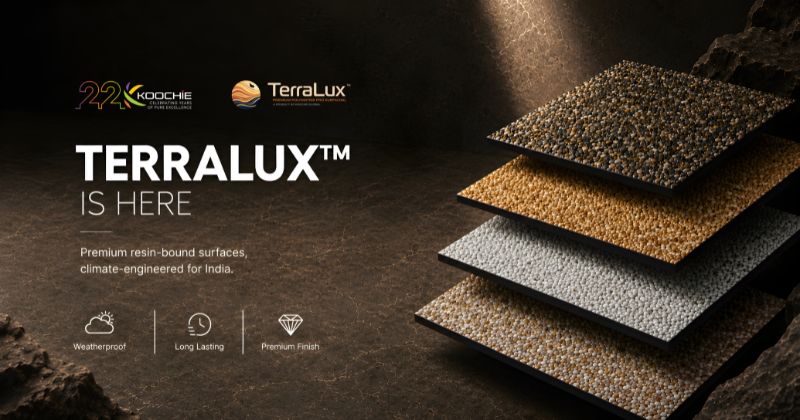
The process begins with natural aggregate — crushed stone, gravel, marble chip, or recycled glass, depending on the specification. That aggregate is thoroughly mixed with a clear or pigmented resin binder until every particle is completely coated.
The mixture is then laid and trowelled to a smooth, consistent finish.
When it cures, the result is a monolithic surface in which the aggregate is fully encapsulated within the resin matrix. Nothing is loose. Nothing is sitting on top of anything else waiting to be dislodged.
The surface is permeable by design. Water passes through the matrix directly to the drainage layer below, eliminating standing water, reducing runoff, and keeping the surface dry underfoot even immediately after rain.
For Indian conditions — where monsoon drainage is a live engineering concern on almost every outdoor specification — this is not a minor advantage. It removes an entire category of surface failure from the equation.
The aesthetic range is wide. The aggregate choice determines the final colour and texture, which means the surface can be matched to almost any architectural palette — from warm sandstone tones for heritage contexts to cool grey aggregates for contemporary development.
The cost of a surface that fails — in remediation, in reputational damage, in the visible deterioration of a space designed to impress — far exceeds the cost of specifying correctly the first time.
Why Conventional Resin Systems Fail in India
Resin-bound surfacing has a significant track record in European markets. The problem is that most of the formulations developed for those markets were engineered for European conditions – moderate UV exposure, temperate thermal cycling, and humidity patterns that bear little resemblance to what a surface faces in Delhi, Mumbai, or Chennai.
The first failure mode is UV degradation. Resins that are not UV-stabilised yellow visibly within weeks of installation under Indian sun exposure. The discolouration is not subtle. A surface that was specified for its aesthetic quality begins to look compromised before the building it serves has been fully occupied.
This is not a maintenance issue. It is a chemistry issue. The resin was not formulated to resist the UV index it is experiencing. The second failure mode is thermal stress.
Indian summers drive ground temperatures significantly above air temperature. Surfaces expand under heat and contract at night. Conventional resin formulations that do not account for the thermal cycling specific to tropical climates develop stress fractures along joints and edges over time.
Once the fracture appears, water infiltration accelerates the failure. The third failure mode is moisture sensitivity during installation.
Resin and moisture are incompatible during curing. In India, where ambient humidity is high for much of the year and monsoon patterns can be unpredictable, conventional installation windows are narrow and the margin for error is slim.
A system not designed for high-humidity installation conditions will produce clouding, bubbling, or adhesion failure — defects that are visible immediately and impossible to reverse without removing and relaying the surface.
What TERRALUX™ Does Differently
TERRALUX™ PolyMatrix Pro System is not a European resin system adapted for India. It is a surfacing system engineered from the specification stage for the climatic realities of the Indian subcontinent and comparable tropical environments.
The resin formulation is UV-stabilised as a baseline requirement, not an optional upgrade. The chemistry accounts for the UV index that Indian installations will face across their service life.
Yellowing and discolouration are addressed at the material level, not managed through post-installation maintenance.
The system is formulated for thermal stability under the temperature cycling that Indian outdoor surfaces experience — high heat during the day, significant cooling at night, and sustained thermal stress across summer months. The PolyMatrix Pro formulation maintains structural integrity through this cycling without developing the stress fractures that conventional systems accumulate over time. For architects and developers, the practical implication is straightforward:
A TERRALUX™ installation does not look better at handover than it does in year five. The surface that is specified is the surface that remains.
The Track Record That Precedes the India Launch
TERRALUX™ did not arrive in India as a new product seeking its first installation. It arrived with a verified track record across some of the Middle East’s most demanding and prestigious environments—climates that, in many ways, represent a more extreme version of what Indian surfaces face.
The Abu Dhabi Equestrian Club. A facility where surface performance is not aspirational—it is operational. The surface specification at an equestrian club is tested daily by weather, weight, and use in a way that most architectural surfaces never experience in their entire service life.
The Dubai Desert Conservation Centre. An environmental institution where material choices carry a specific weight. A conservation organisation does not select a surface that contradicts its values or compromises its environmental standards. TERRALUX™ was the specification at that level of scrutiny.
Beeah in Sharjah—one of the most respected sustainability and environmental management organisations in the Middle East. And Square Nad Al Sheiba in Dubai, where the surface delivers in a premium residential and mixed-use context.
The India launch is anchored by the DLF installation—the country’s largest real estate developer choosing TERRALUX™ as the surface specification for a flagship project. That is the introduction the product makes in the Indian market.
Where TERRALUX™ Belongs in the Specification
TERRALUX™ is available through Koochie Global’s Architectural Surfaces Division for specification across driveways, pedestrian walkways, park and garden surfaces, podium decks, pool surrounds, and landscaped communal areas.
The architect or landscape consultant who specifies TERRALUX™ is not making a premium choice for its own sake. They are making a rational choice for a client who does not want to revisit the surface specification in five years. The cost of a surface that fails — in remediation, in reputational damage to the development, in the visible deterioration of a space that was designed to impress — far exceeds the cost of specifying correctly the first time.
The specification decision is the architect’s. The surface that follows from it will reflect on the development, and on the specification, for the life of the building. TERRALUX™ is built to make that reflection a positive one.
The Surface That Defines the Space
The best architectural surfaces are the ones that do not announce themselves. They simply make the space feel the way it was designed to feel — year after year, through every season, without intervention. In India, achieving that has required a surface system that was actually designed for what India asks of it.
TERRALUX™ PolyMatrix Pro System, available through Koochie Global’s Architectural Surfaces Division, is that system. Resin-bound. Climate-engineered. Architect-specified. Built to outlast the assumptions that have compromised every alternative before it. Surfaces that define spaces. That is what TERRALUX™ was built to be