
Introduction
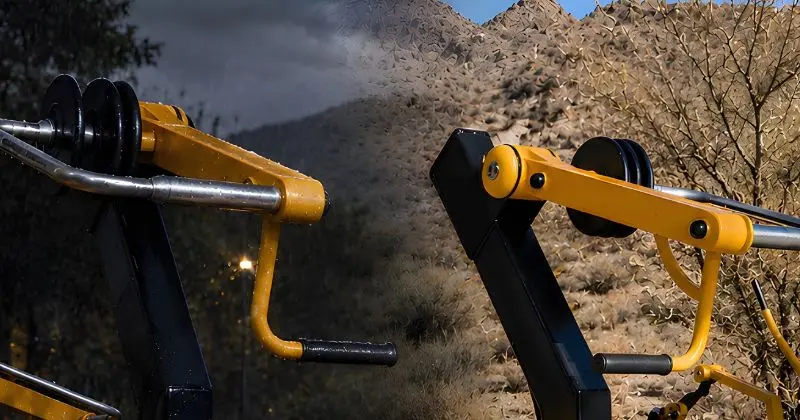
Why Weather-Resistant Outdoor Gym Equipment Matters for Long-Term Durability
Outdoor fitness infrastructure occupies a uniquely demanding position among all categories of built assets. Unlike indoor gym equipment, which operates in a controlled environment, outdoor equipment faces continuous, unrelenting exposure to conditions that are impossible to replicate in a testing lab and impossible to avoid in the field.
In India alone, the range of climatic stresses is extraordinary. Equipment installed in Bengaluru faces months of sustained monsoon rainfall, high humidity, and temperature variation across seasons. Coastal installations in Chennai or Mumbai contend with salt-laden air that accelerates corrosion at a rate that inland environments do not. Equipment in Rajasthan faces sustained UV exposure and heat levels that test surface coatings, seals, and structural materials simultaneously. Equipment in the hills faces freeze and thaw cycles that test every weld, every joint, and every fastener.
This is not a niche engineering problem. It is the baseline reality for every piece of outdoor fitness equipment installed anywhere in the country. And it is the reason that the specification of outdoor fitness infrastructure requires a fundamentally different standard to indoor equipment.
What Weather Actually Does to Equipment
The mechanisms of outdoor degradation are well understood by engineers and largely invisible to procurement teams until the damage is already done.
UV radiation does not simply fade colour. Over time, sustained UV exposure breaks down the polymer chains in surface coatings, causing brittleness, cracking, and eventual failure of the protective layer that sits between the structural steel and the atmosphere. Once that layer is compromised, corrosion accelerates sharply.
Humidity and rainfall create the conditions for electrochemical corrosion, particularly at weld points, joints, and any location where dissimilar metals meet. Coastal salt air compounds this dramatically, introducing chloride ions that penetrate even intact surface coatings over time and initiate corrosion from within the material.
Thermal cycling, the repeated expansion and contraction of materials as temperatures rise and fall, places mechanical stress on every connection point in the structure. Over years of cycling, this stress manifests as micro-fatigue in welds, loosening of fasteners, and cracking at stress concentration points.
High-frequency public use adds the mechanical dimension. Equipment in a public park or residential development is used continuously, by people of varying weights, fitness levels, and movement patterns, every day. The cumulative loading on structural components far exceeds anything indoor equipment faces.
The Koochie Global Engineering Response
Koochie Global designs outdoor fitness infrastructure with the specific intention of performing through all of these conditions across a full operational life. This is not a marketing claim. It is reflected in the certifications the equipment carries and the engineering decisions behind every component.
UV-resistant surface coatings are applied to all Koochie Global installations. These are not standard decorative coatings. They are formulated to maintain both structural and aesthetic integrity under sustained solar exposure, resisting the polymer degradation that causes conventional coatings to fail.
Anti-corrosion steel treating is applied as a standard, not an upgrade. High-humidity and coastal installation environments demand a baseline level of corrosion protection that goes beyond standard powder coating. Koochie Global’s material specification reflects this.
Structural engineering accounts for the mechanical demands of high-frequency public use across diverse user populations. Load-bearing components are specified and tested for the cumulative loading they will actually face over years of continuous use, not the idealised loading of a controlled laboratory test.
This engineering approach is reflected in the certifications Koochie Global holds. TÜV certification represents independent verification of structural integrity and safety by one of the world’s most authoritative engineering bodies. EN16630 compliance confirms the equipment meets the European Standard designed specifically for outdoor fitness installations in public spaces. The AS 4685 standard adds the Australian benchmark for outdoor fitness equipment, which addresses climatic and mechanical performance across the full range of outdoor operating conditions. Together, these certifications are not a sales point. They are independent verification that the engineering performs as specified.
What This Means for Developers and Facility Managers
For the decision makers who commission outdoor fitness infrastructure, the practical implication of equipment engineering is a question of total cost over time, not purchase price.
Equipment that degrades rapidly within its first three to five years generates replacement costs, safety liability, and community dissatisfaction at a rate that makes the initial cost saving irrelevant. Equipment that performs across a full ten to fifteen year operational life while remaining safe, structurally sound, and visually maintained delivers a return on investment that inferior products structurally cannot match.
For residential developers, the quality of community infrastructure is a direct signal to residents about the long-term commitment of the developer to the spaces they have created. Equipment that rusts, fades, or fails within a few years of installation communicates something about the development that no marketing can undo.
For municipal bodies and civic organisations, outdoor fitness infrastructure that performs across its full intended life reduces the operational burden on public budgets, eliminates the safety risks associated with degraded equipment, and maintains the quality of the public spaces that communities depend on.
The Standard Worth Building To
Koochie Global has been building outdoor fitness, playground, and sports infrastructure for over twenty two years. In that time, the company has installed across a range of climates, geographies, and user environments that represents one of the most comprehensive real-world testing programmes any manufacturer in this category could have.
The lesson from that experience is straightforward. The outdoor environment is unforgiving. Equipment that is engineered to meet it without compromise lasts. Equipment that is not, does not.
Built for the world. Built to last. Built for everyone.