
Introduction
Safety standards describe age bands carefully. Project briefs rarely do. The result is a generation
of residential and civic spaces that serve younger children well and give adolescents very little
reason to stay. Koochie Global builds across both ends of that range, and this piece sets out what
actually changes between eight and fourteen.
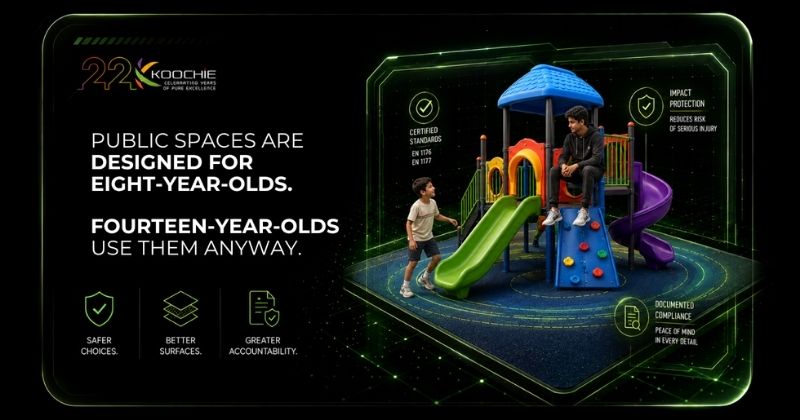
The Age Band That Falls Out of the Brief
Most play area briefs arrive with a single instruction: a children’s play area, so many square feet, within the landscaped zone. The equipment that follows is specified for the age group that is easiest to picture, roughly four to ten. Swings, slides, a climbing frame, a soft surface underneath. All of it correct, certified, and appropriate.
What happens next is predictable to anyone who has watched a residential development mature. The children who were six at handover are eleven three years later, and fourteen a few years after that. The equipment has not changed. Research on adolescent use of public space finds this repeatedly: teenagers describe small swings, low slides, and basic playgrounds as built for younger children, and read the absence of anything for them as a signal that the space is not theirs. Teenagers are among the least served groups during out-of-school hours in most public space provision.
They keep showing up regardless. Roughly eighty percent of teenagers report preferring to be outdoors rather than indoors, and over thirty percent regularly use streets and parks to socialise. The demand is there. The provision usually is not.
Where Koochie Global Designs for the Older End
Koochie Global has been building play, sports, and fitness infrastructure since 2004, and the range reflects the fact that a public space serves several ages at once. Koochie Play covers the younger end, with structures certified to EN 1176 and surfacing to EN 1177. Koochie Sports covers courts, pitches, and tracks. Techton™ covers outdoor fitness, and it is the part of the range that speaks most directly to the fourteen-year-old.
Titan by Techton™ is plate-loaded outdoor strength equipment. Krypton by Techton™ is self-powered kinetic cardio. Both are certified to EN 16630, the European standard for permanently installed outdoor fitness equipment, and tested to TÜV SUD standard. They matter in this conversation because they offer an adolescent something a climbing frame cannot: resistance that can be increased, progress that can be measured, and a reason to come back tomorrow rather than once.
What Changes Between Eight and Fourteen
The body changes what counts as difficult. At eight, reaching the top of the ladder is the achievement. At fourteen, the same ladder is a staircase. Adolescent bodies are stronger, taller, and better coordinated, and equipment that offered a genuine physical problem six years earlier now offers none. Graduated difficulty, holds that resist, heights that require commitment, loads that can be added, is what keeps a space usable across that span.
The social function changes entirely. Play researchers describe a shift as children grow older, from settings that afford play opportunities toward places that offer the chance to socialise, to be with peers, or to be alone. A fourteen-year-old is often in a public space to talk, to watch, and to be seen. Seating, shade, and sightlines carry as much weight for that user as any piece of equipment.
Risk becomes the point. Adolescents actively seek settings with an element of risk, and skate parks, climbing walls, and sports courts are consistently well used because they provide physical challenge alongside social visibility. This is documented as developmentally necessary rather than incidental, contributing to identity and a sense of belonging. Where facilities are designed with teenagers in mind, usage among that group runs as high as seventy three percent.
Challenge and Safety Are Both Specifiable
Designing for adolescent challenge does not sit in tension with the standards. EN 1176 caps free height of fall at three metres, and above that figure equipment falls outside the scope of the standard regardless of what surfacing sits below it. That ceiling leaves considerable room. A structure can be demanding, tall, and physically committing while remaining fully within certification, and the surfacing beneath it can be specified to EN 1177 for the actual fall height rather than a notional one.
The more common failure is the opposite of over-ambition. Equipment gets specified well below what the standard permits, the space reads as juvenile to anyone over eleven, and the adolescents who use it anyway do so in ways it was never designed for. Koochie Global’s certifications across EN 1176, EN 1177, EN 16630, IPEMA, and AS 4685 exist to give a specifier room to design at the upper end of what is safe rather than the lower end of what is defensible.
The Design That Excludes Without Saying So
Some exclusion of adolescents from public space is deliberate and physical. Anti-skateboard brackets on planter walls, railings, and walkways are a documented example, as are curfews and loitering rules. Most of it in residential and civic projects is quieter than that. It is simply a space with nothing in it for a fourteen-year-old, which produces the same outcome without anyone having decided on it.
Jane Jacobs observed decades ago that adolescents are routinely criticised for loitering, and that “they can hardly grow up without it.” The behaviour that reads to adults as aimless, standing around, talking, taking up space, is the activity. A design that provides nowhere to do it has not removed the need.
Adolescent Girls Are a Separate Design Question
Provision aimed at teenagers often defaults to a single format, typically a hard court or a skate area, which in practice serves boys more readily than girls. UN-Habitat’s Her City report found nine in ten women reporting feeling unsafe in public spaces. Recent redesigns have started addressing this directly: Brickfields Park in Bath was reworked specifically around the needs of teenage girls, and comparable work has been carried out in Vienna.
The practical design implications are consistent across that work. Grouped seating that supports conversation rather than a single bench facing a court. Good lighting and clear sightlines. Equipment placed so that using it does not mean performing in front of an audience. Multiple activity types in one area rather than one dominant use. None of it is expensive. It has to be in the brief.
Koochie Global answers this through range rather than through a single dedicated product. Because Koochie Play, Koochie Sports, and Techton™ can be specified into the same site, an outdoor space does not have to resolve into one dominant use. A court can sit alongside outdoor fitness and grouped seating rather than occupying the area by itself, which gives an adolescent girl somewhere to go that is neither the court nor the edge of it. Titan by Techton™ and Krypton by Techton™ offer her the same progressive strength and cardio provision as any other user of the space, at a scale and resistance she sets herself. The remaining decisions are positional: where the seating faces, how the lighting runs after dark, and whether using a piece of equipment means performing in front of a queue. Those are settled on the layout drawing, and Koochie Global’s team can work through them against a site plan before the package is issued.
What to Ask For at Brief Stage
The useful question at the start of a project is not how large the play area should be. It is which ages will be using this space in year one, year five, and year ten, and what each of them will find here.
Worth specifying explicitly: the age range the equipment is intended to serve, stated as a range rather than left implied; at least one element offering graduated difficulty so the space does not expire as its users grow; outdoor fitness provision where the resident profile includes adolescents; seating and shade sized for groups rather than individuals; and lighting and sightlines reviewed for the older users who will be there later in the evening. Koochie Global’s team can review an age-range brief against the available range before a package goes out.