
How Koochie Global Plans for Light, Shade and Short Afternoons
The monsoon is easing, the winter break is coming, and the neighbourhood park is about to be used in a different way. Here is a walk through one winter day, hour by hour, and what Koochie Global plans so the light, the shade and the ground work for the families who turn up.
Seven in the Morning, Sweater On
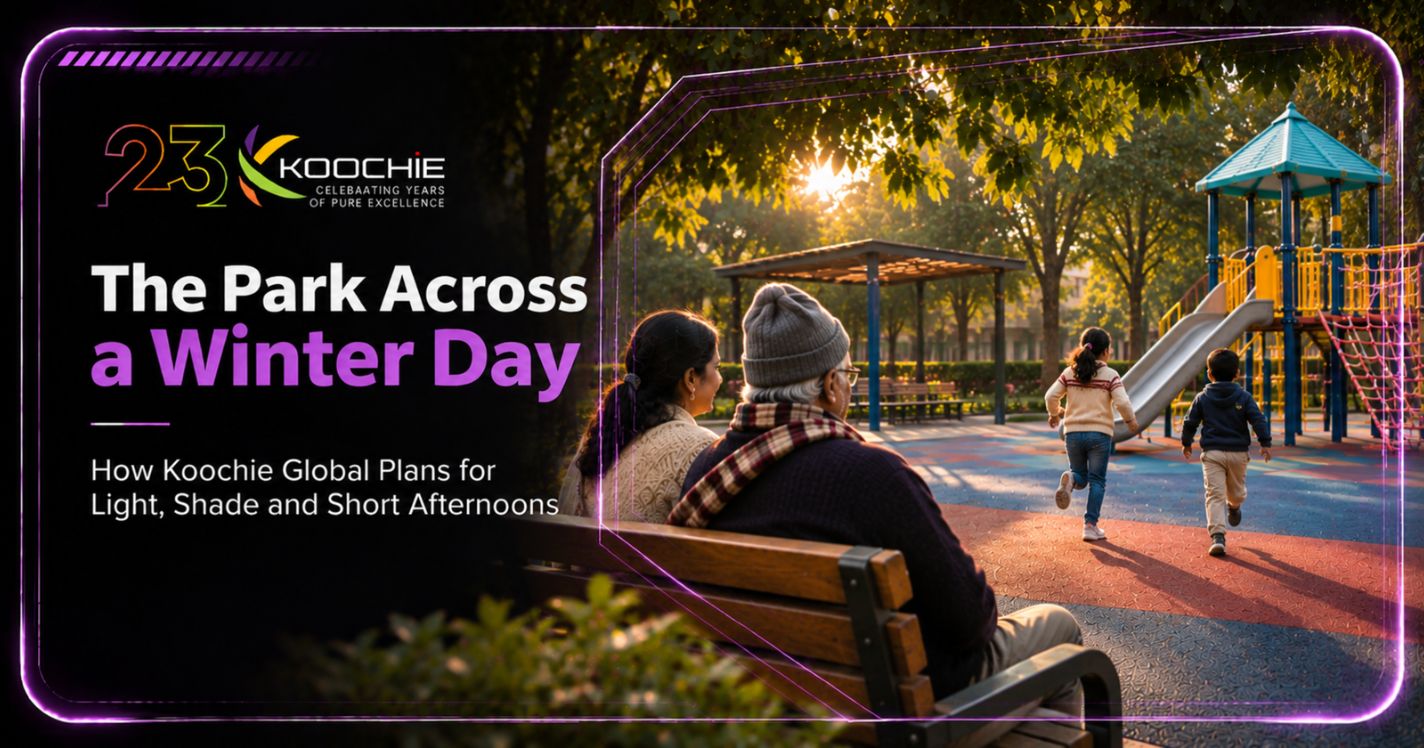
Picture a grandfather in a woollen cap, a child care helper holding a flask, and a six year old who has been awake since before anyone asked her to be. The grass is still wet. The first sun is just clearing the trees, and the only warm spot in the whole park is a patch of light on one end of a bench.
That patch matters more than it seems. Morning is when a park tells you how well it was planned. At Koochie Global, we design play areas and play towns for homes, schools, campuses and public parks, and we have seen thousands of facilities at every hour of the day. The ones families love in winter tend to share a few habits:
Water has somewhere to go. After the monsoon, the question is how quickly the ground drains and dries, so a child can start playing instead of waiting for the puddle to leave. We look at how water moves across the site before we look at equipment.
Seating meets the first sun. A bench placed to catch the morning light is where an older relative will settle for an hour. When the adults are comfortable, the children get a longer morning.
Surfacing is checked, not assumed. Our safety flooring uses EPDM and is planned against EN 1177, the European standard for impact-absorbing playground surfacing. Cold mornings are a good time to walk the fall zones and look for wear.
Winter Flips the Shade Question
In summer, shade is the prize. Everyone heads for the tree, and the best seat in the park is the one under it. Winter turns that around. By late morning, the shade can feel cool, and the sun is what people look for.
So Koochie Global plans for both, and that is really the whole idea behind a playground designed for all seasons. Think about it this way: a good park gives people a choice at every hour, and lets them make it themselves. A grandparent can pick the bright bench or the shaded one. A child who has been running can cool down in the shade, then go back to the sun.
Sun pockets for sitting. Seating placed where winter light reaches, with a clear view of the play area.
Shade for resting. Cover near the equipment, so a break from the sun does not mean leaving the game.
Choice within sight. Both kinds of seat close enough together that one adult can watch the whole play area from either.
In summer, we look for shade. In winter, we look for the sun. A park that plans for both can be used from the first light of morning to the last of the evening.
The Winter Break Changes Who Is at the Park
During term, a neighbourhood park is mostly an evening place. Children arrive after school, tired and hungry, with an hour before homework. Then the holidays begin, and suddenly the park belongs to children at ten in the morning, at noon and at four in the afternoon. They arrive in mixed ages, often in groups, and they have time.
That changes what a play area has to do. A tower that holds a six year old for twenty minutes is not enough for a whole holiday afternoon, so Koochie Global designs by age band, with graded challenge, so a child can start on a low balance beam and move up to the high one over the course of the break. Older children get something real to climb, younger ones get a place that is their own, and they can all play near each other.
Weather is part of this too. In a Gallup survey of US parents, most said they wanted their children to play outdoors more, and poor weather was one of the reasons given for why it does not happen, cited by 36 percent. The study is American, and Indian winters are milder in most cities, but the point carries over. Families usually want to be outside. A park that is comfortable across the day removes the reasons not to be.
Golden Hour Is Short, So Plan for It
In late November, the sun sets before 6 pm in much of India, which means the warm, low light that makes a park look its best lasts only a short while. It is also when the park is fullest, as school children, office workers and walkers all arrive together.
Low sun brings its own details. Long shadows cross the ground, glare can make it hard to see across a play area, and the temperature drops quickly once the sun dips. This is the hour Koochie Global plans around:
Clear sightlines. Adults on the bench should be able to see every part of the play area without squinting into the setting sun.
Fall zones kept clear. The space under and around each piece of equipment stays free of bags, bicycles and benches, so the surfacing can do its job when the park is crowded.
Room to gather. Places for children to stop, talk and trade turns, because the last hour of daylight is often the most social.
After Six, the Park Is Lit or It Is Empty
Sunset in winter does not end the day at the park, but it does decide who stays. Families with young children head home when paths go dark, and the people who remain are usually the ones who feel safe in the light.
That is why lighting belongs in the first design conversation and not the last. Well-lit paths, a visible gate, seating near the lights and a clear line from the entrance to the play area help parents, grandparents and child care helpers stay a little longer. It also helps the other users who share the park after dark.
Koochie Global places Techton™ outdoor fitness equipment near the play area, built to EN 16630, so an adult can exercise within sight of the children, and a lit evening park works for the whole family at once.
A Winter Break Plan for Schools and Societies
If you manage a school campus, a housing society or an RWA play area, the weeks before the break are the best time to walk the site. It is a short list, and most of it takes an afternoon:
Surfacing. Look for wear, gaps and compacted patches under the equipment, and confirm fall zones are clear, measured against EN 1177.
Equipment. Check fixings, moving parts and finishes on everything children climb or swing on. Equipment from Koochie Global is built to EN 1176 and certified by TÜV SÜD.
Sun and shade. Look at where the winter sun actually falls, then check that seating covers both warm and shaded options.
Lighting. Stand at the gate at 5.30 pm and see what a parent sees. Fix the dark patches first.
The way in. Make sure the path from the gate to the play area is flush, firm and free of raised lips, so every child and every adult can reach it.
Most of this is easier to plan at the start than to add later, which is why Koochie Global likes to join a project at the design stage and stay with it through to handover. If you have a play area to refresh or a new one to plan, talk to us at koochieglobal.com and bring the children who will use it into the brief. They will tell you exactly which hour of the day matters most.
Koochie Global. Built for the world. Built to last. Built for everyone.