
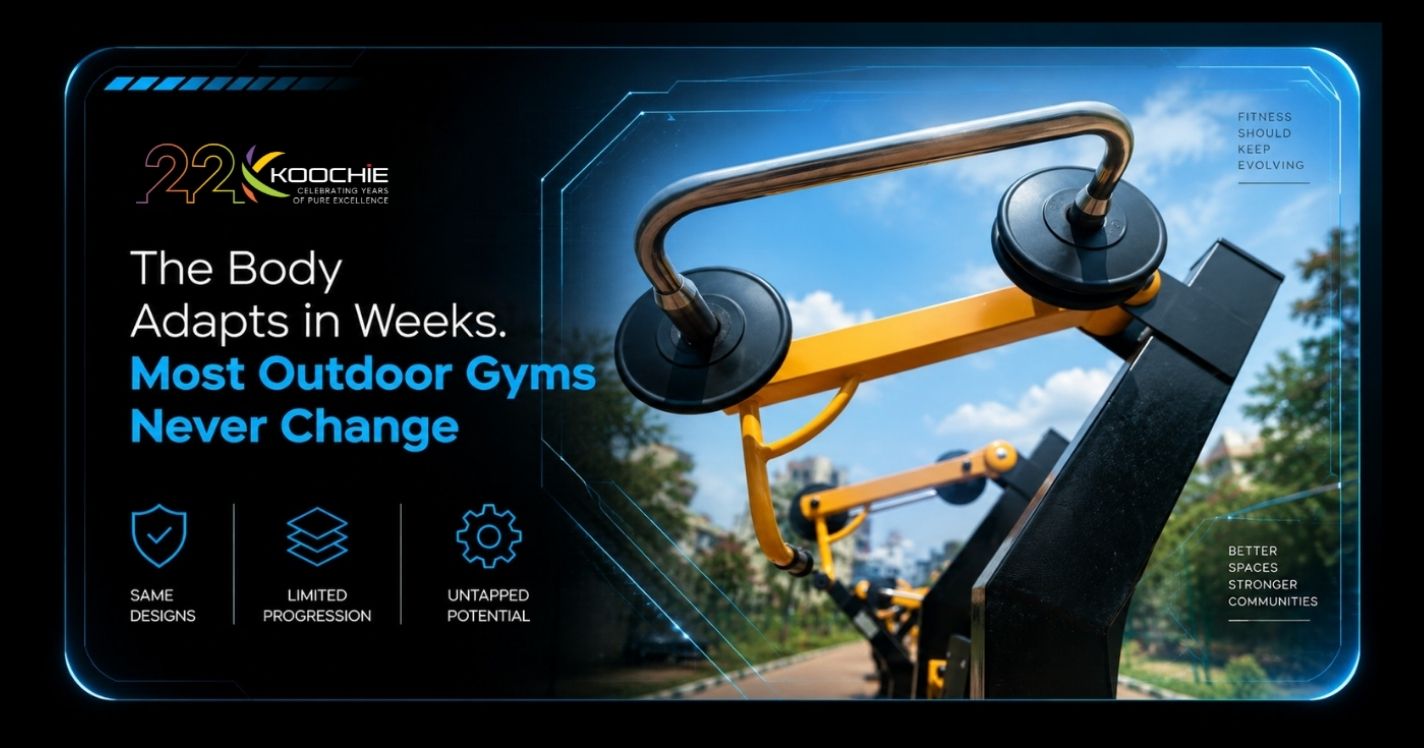
Every society outdoor gym is busy in its first month and quiet by its third. The usual explanations are maintenance and motivation. The more consistent one is that the equipment offers the same resistance on day ninety as it did on day one, and a body that has adapted to a load stops responding to it. Titan by Techton™ is plate loaded for that reason.
The Month Three Problem
Anyone who manages a residential community knows the pattern. A new outdoor gym is installed and for a few weeks it is the most used amenity on the site. Then attendance thins. By the third month a handful of regulars remain, usually older residents walking in the morning, and the equipment settles into the background of the landscape.
Maintenance is the usual explanation, and where equipment has seized or corroded it is the correct one. But the same fade happens on installations that are still in perfectly good working order. Something else is going on, and it has less to do with the equipment breaking than with the equipment staying exactly the same.
What Progressive Overload Actually Requires
The principle underneath all strength training is progressive overload. A muscle adapts to the demand placed on it, and once it has adapted, the same demand no longer produces a response. To keep making progress the stress has to increase.
That increase can come from more than one variable. Published comparisons of load progression against repetition progression have found both to be viable routes to muscular adaptation over a training cycle, with load favouring strength gains slightly and repetitions favouring hypertrophy slightly. Bodyweight training is not inferior in principle either. Where volume and intensity are matched, calisthenics has been shown to produce comparable strength and hypertrophy outcomes to loaded training.
So the argument is not that bodyweight or leverage based equipment fails to build strength. It is narrower and more practical. Progressive overload requires that some variable can move, and it requires that the user can keep moving it. Fixed resistance equipment leaves repetitions as the only available lever, and repetitions alone run into a ceiling faster than load does, particularly for the lower body, where research consistently notes that bodyweight progressions are the hardest to extend.
What Gets Cut, and What Koochie Global Marks First
Surfacing depth is the clearest example, because it looks like a single number and is actually several. A critical fall height calculation produces a different required depth under a three metre platform than under a balance beam forty centimetres off the ground. The specification reflects that, station by station.
A budget committee working from a cost sheet does not usually see it station by station. It sees a single surfacing line item and asks whether the figure can come down uniformly across the site. A uniform reduction is an easy number to approve and an easy number to defend, and it is invisible on the day of handover, because the surfacing still looks like surfacing under every piece of equipment. It only becomes visible under the tallest structure on site, at the exact moment it is tested against the standard it was originally calculated to meet.
UV stabilisation fails the same way for a different reason. A stabilised and an unstabilised compound look identical in a sample and cost different amounts on the invoice. Removing the stabiliser is a cut that shows nothing wrong for months, which makes it one of the easiest lines in the whole document to take out, and one of the hardest to notice was ever taken.
Equipment substitution is the same failure wearing a different name. A specified unit swapped for a visually similar one, to trim supply cost, can look identical in a render while carrying a different EN 1176 test report, or none at all. All three cuts are the kind a budget committee can make and never learn it made, unless it was already told, before the cost sheet ever reached the table, exactly which lines Koochie Global has marked as fixed.
"Equipment that cannot get harder is equipment with an expiry date."
Where Titan by Techton™ Is Different
Titan by Techton™ is plate loaded outdoor strength equipment. The user selects the resistance rather than accepting whatever the geometry of the frame provides. That single design decision changes what the installation can do over time. A resident who has adapted to a given weight moves up. A resident starting from a lower base starts lower. Two people of very different strength use the same station on the same morning without either of them being poorly served by it.
The range is built as a circuit rather than a single station, which is what makes the selectable load argument hold across an entire body rather than one muscle group. A chest press and a shoulder press cover the push side of the upper body. A lat pulldown and a seated row cover the pull side. A leg press and a leg curl carry the lower body, with a dedicated arm curl station and a core trainer rounding out the circuit. Every one of those stations is plate loaded on the same principle as the first, so the progression argument does not stop at one machine.
It also gives the user something to measure. Progress that can be observed is progress that produces a reason to return, which is the difference between an amenity that is used and an amenity that was installed. Krypton by Techton™ covers the cardio side of the same installation, self powered so it requires no electrical supply at the location.
Putting a Selectable Load Outdoors Is the Hard Part
There is a straightforward reason most outdoor fitness equipment in India uses fixed leverage rather than a selectable weight stack. Fixed leverage has almost nothing to go wrong. A plate loaded mechanism has moving parts, guide rods, bearings and a stack that has to run smoothly after several monsoons and several summers, in a location with no roof and no attendant.
That is an engineering problem before it is a fitness one, and it is where the Techton™ specification does its work. Every steel component, on the chest press station as much as the leg press, runs through a seven stage process before it reaches a site. Structural grade selection, full sandblasting to strip mill scale, a flow coated anti corrosion primer, complete submersion in molten zinc to form a sacrificial galvanic layer, and an AkzoNobel Interpon powder coat over that.
Formulations are tested to perform at 55 degrees Celsius and 99 percent relative humidity, which is a reasonable description of an Indian summer followed by an Indian monsoon.
Techton™ equipment is certified to EN 16630, the European standard for permanently installed outdoor fitness equipment, and tested to TÜV SÜD standard. EN 16630 is the correct reference point for this category specifically, as distinct from the playground standards that cover children’s play equipment.
Who the Selectable Load Actually Serves
The assumption behind fixed resistance equipment is a single average user. In a residential community that user does not exist. A society outdoor gym is used by teenagers, by adults across a wide range of training experience, and by older residents for whom the starting resistance matters more than the ceiling.
A fixed station is calibrated for one point on that distribution and is either too easy or too demanding for everyone else. A selectable load lets the same footprint serve the whole range, which matters on a site where the space allocated to fitness is usually a single corner and will not be extended later.
The same argument scales further in a public park than it does inside a single residential community. A society gym serves the families of one site. A park gym serves whoever walks in, across every age group and every fitness history a neighbourhood contains, with no membership and no gate. If a single average user was already a fiction inside one residential community, it is a bigger one across a public park’s footfall, which is precisely why the selectable range needs to be planned wide from the outset rather than sized to the calmest possible user.
What to Ask at Brief Stage
Three questions, none of which require a product decision to have been made.
Can the resistance be changed by the user? If the answer is no, the installation has a functional life measured in months rather than years, regardless of how long the steel lasts.
What is the starting resistance, and how is the ceiling extended? A plate loaded system answers this differently to a fixed weight stack. The starting resistance is simply how few plates a first time or older user is given to work with. The ceiling is not cast into the machine at manufacture, it is set by how many plates the site chooses to hold at the station, which means a community that starts with a modest range is not committed to it. More plates arrive when the regulars need them, without a fresh installation.
What protects the mechanism, not just the frame? Powder coat thickness describes the finish. Ask what happens beneath it, and ask specifically about the moving parts, since those are what fail first on a selectable load system and what determine whether the resistance is still adjustable in year five.
One Specification, Made Early
Titan and Krypton are built as one system for exactly this reason. Strength that can be added to. Cardio that never needs a socket. Both engineered by the same team that is still answering for the steel in year five. That is the difference between buying equipment and specifying a facility.
Specify for the user who is still coming back in year three, and build the range wide enough that they still have somewhere to go.