
Introduction
On what separates outdoor installations that hold their finish for a decade from those that start turning to rust before the second monsoon.
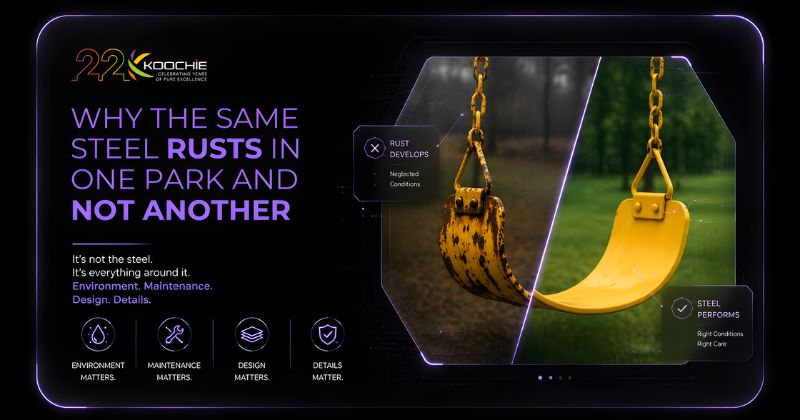
Two Parks, One Question
Picture two public parks in the same city. Both installed outdoor fitness equipment around the same time. Both sit under the same sun, take the same monsoon, see roughly the same foot traffic.
Walk through one today and the equipment looks the way it did on installation day. Walk through the other and the frames have gone the colour of rust, the joints have started to seize, and a few pieces have quietly been fenced off.
Same climate. Same years. Same category of equipment. Different outcome entirely.
The question worth answering is a straightforward one: what separated the two parks was never the weather. It was what happened inside a factory, long before either installation reached its site.
Why Most of the Market Skips This Step
The Koochie Standard
At Koochie Global, hot dip galvanisation is not an upgrade or an optional line item. It is a foundational step in every installation we build, followed by a full powder coating system, and certified to TUV SUD and EN 16630 standards.
Over twenty-two years and across 23 locations worldwide, this process has not changed, because the outcome it produces has never needed to. The park that still looks the way it did on day one is the one where this step was never treated as optional.
The Myth of Inevitable Rust
Most people have seen it happen. A swing set, a railing, a piece of park equipment, slowly turning orange within a year or two. So the assumption feels fair. Metal outdoors equals rust, eventually.
But rust is not a rule. It is a result of specific choices made long before the equipment ever reaches a park. The two parks above did not have different weather. They had different steel, prepared differently, before either installation ever left the factory.
What Actually Separates Them
Three things determine whether outdoor equipment corrodes. The grade of steel used. Whether it goes through hot dip galvanisation. And the quality of the powder coating applied on top.
Hot dip galvanisation is the step that does the real work. The steel is submerged in molten zinc, which bonds to the surface and creates a layer that corrodes in the steel’s place. It is, in a literal sense, a sacrificial layer. As long as it is intact, the steel underneath stays protected, even where the surface gets scratched or chipped.
Powder coating goes on after that, sealing out moisture and UV exposure, and giving the surface its finished colour. Skip the galvanisation and coat raw or poorly prepared steel directly, and the coating is only ever as good as what is underneath it. The first scratch becomes the first rust spot.
Skip any one of these three steps, and rust becomes a matter of when, not if. The weather was never the variable.
Koochie's Preventative Process
01 Steel selection
Structural-grade steel specified for outdoor load and climate exposure.
02 Surface preparation
Full sandblasting to remove mill scale and contaminants.
03 Flow coating
04 Hot dip galvanisation
05 Powder coating
06 Certification
07 After-installation
How to Actually Tell the Difference
None of this is visible from a distance on day one. Both parks, freshly installed, look identical. The difference only shows up two or three years in, which is precisely why it matters to ask about it before installation, not after.
TWO QUESTIONS THAT DO MOST OF THE WORK
- Is the steel hot dip galvanised, not just painted or coated directly?
- Is the equipment certified to an international outdoor durability standard, such as EN 16630, which specifically tests for exactly this kind of long-term exposure?
A supplier confident in their process will answer both without hesitation. Koochie Global does both. Every installation is hot dip galvanised and EN 16630 certified. These are not selective claims applied to a premium range. They are the standard specification across every project we deliver, from a single-unit park installation to a multi-phase residential development.
The Two Parks, Revisited
Next time you walk past outdoor equipment that has held its finish for years, it was not luck, and it was not the weather being kind to one park and unkind to another. It was a decision made in a factory, long before either park ever opened.
One park specified the right steel, the right preparation, and the right certification. The other specified a price. Both got exactly what they asked for.
The difference is that one of them is still standing, still in use, still performing to the standard it was certified under. The other is fenced off, waiting for a replacement budget that will cost more than doing it right the first time would have.
For twenty-two years, Koochie Global has built outdoor infrastructure for the conditions it will actually face—not the conditions a spec sheet assumed. That is why the parks, schools, and residential communities that chose this approach are not replacing their equipment. They are still using it.