
Introduction
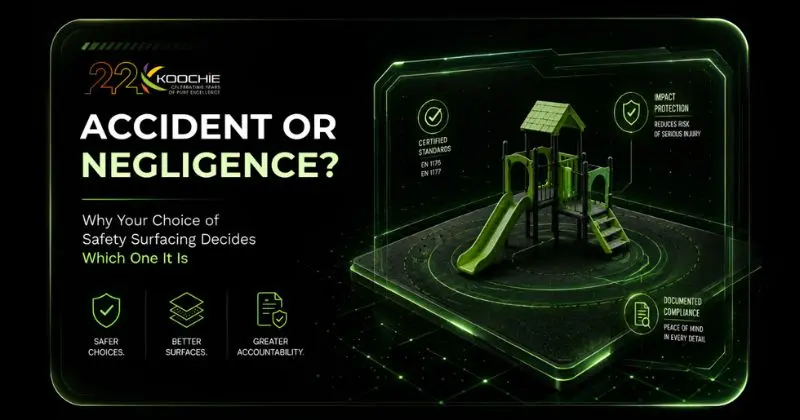
Two Falls, Two Outcomes
A child falls from a climbing structure in a residential playground. In one scenario, the surface beneath them is EN 1177-certified EPDM safety flooring, installed to the correct depth, with verified impact attenuation within published thresholds. The child is shaken, perhaps bruised, but the surface performed exactly as it was designed to. The fall was an accident. The surface did its job.
In the other scenario, the surface is a budget alternative — thinner, uncertified, installed without impact testing. The same fall results in a more severe injury. The surface did not attenuate the impact because it was never specified to. An investigation follows. The question is no longer whether the child fell. The question is whether the entity that approved the surface exercised due diligence in selecting it.
The first scenario is an accident. The second is negligence. The difference between them is not the fall. It is the specification decision made months or years before the fall ever happened.
An accident is what happens when every reasonable measure was in place and something still went wrong. Negligence is what happens when the measure was never in place to begin with.
What EPDM Safety Surfacing Actually Does
EPDM — ethylene propylene diene monomer — rubber safety surfacing is the material specifically engineered to arrest falls beneath play equipment. Its function is singular and non-negotiable: absorb the energy of a child’s fall and reduce the severity of impact to within survivable, non-critical thresholds.
EN 1177, the international standard for impact-absorbing playground surfacing, exists to test exactly this property — the Critical Fall Height (CFH) at which the surface can prevent a life-threatening head injury.
When EPDM surfacing is correctly specified, installed to the right depth, and certified to EN 1177, it creates a documented, testable, defensible safety layer beneath every piece of equipment. That documentation is what separates an accident from a liability event in any post-incident investigation.
At Koochie, every EPDM surfacing installation is EN 1177 certified and tested by TUV. The depth is calculated against the Critical Fall Height of the specific equipment it sits beneath — not applied as a uniform layer. This is the level of specification rigour that holds up under scrutiny because it was designed to.
Where the Budget Decision Creates Liability
Most budget surfacing alternatives look identical to certified EPDM on the day of installation. The colour is right, the texture is close, and the cost is 35 to 40 percent lower. The procurement table tells a compelling story.
What it does not tell you is:
- Whether the material has been tested to EN 1177 for impact attenuation at the installed depth
- Whether the polymer binders include UV stabilisers rated for Indian climate exposure
- Whether the drainage substrate will hold its structure through monsoon cycles
- Whether the surface will still meet its original impact performance at year two, let alone year five
Within twelve to eighteen months, uncertified surfaces begin to degrade. They turn tacky in heat, brittle in cold. The impact-absorbing properties diminish as the binder breaks down. By year three, the surface no longer performs to any published safety threshold. If a fall occurs at that point, the entity that approved the surface is not defending an accident. It is defending a material choice.
Koochie’s EPDM specification process eliminates this exposure from the outset. Our formulations are tested for performance at temperatures up to 55°C and humidity levels up to 99%, because a surface specified for European conditions and deployed in Indian climate is a liability waiting to materialise.
The Liability Arithmetic
The cost comparison between certified EPDM and budget surfacing is not a savings calculation. It is a risk transfer.
Certified EPDM (EN 1177
Full cost upfront → documented impact performance → defensible in any investigation → liability sits with the accident, not the specification.
Uncertified budget surface
35% savings upfront → unverified impact performance → indefensible if degradation is proven → liability sits with the specifier, the approver, and the installer.
When the total cost is tallied, the budget path consistently costs 180 to 220 percent of what the certified path would have cost — and that is before any legal or insurance exposure is factored in. With it, the cost becomes unquantifiable.
At Koochie, we walk every client through this arithmetic before the specification is finalised. We present lifecycle cost per year of certified, defensible performance — not unit cost per square metre — because that is the number that determines whether the investment protects the client as much as it protects the child.
The Costs That Follow Negligence
When a surface fails and an injury occurs, the replacement invoice is only the visible cost. Four other liabilities compound beneath it:
- Certification void: A surface that was never certified, or that has fallen below its certified threshold, offers no documentation in a dispute. The site owner absorbs the full liability gap.
- Insurance challenge: Claims become contested when the insurer discovers the surface was not installed or maintained to a published standard. Coverage may be denied.
- Contractor exposure: The installer says it was not maintained. The developer says the material failed. Without EN 1177 certification as a baseline, there is no objective standard to adjudicate against.
- Reputational damage: A child injured on a surface that was never specified to protect them is not a story about an accident. It is a story about a decision.
Koochie’s post-installation support is designed to ensure that the certified status of every EPDM surface we install remains intact for the life of the installation. Our after-sales engagement includes maintenance guidance documentation, periodic check-in scheduling, and a direct line to our technical team — not just for the warranty period, but for as long as the surface is in service.
Getting It Right from Day One
One project understood this distinction early. The specification called for EN 1177-certified EPDM safety surfacing, depth-matched to the Critical Fall Height of every piece of equipment on site, with UV-stabilised binders and a documented maintenance protocol.
Five years in: near-zero unplanned maintenance. Surface still performing to its certified impact attenuation standard. Documentation intact. No replacement cycle on the horizon.
If a child falls on that surface tomorrow, it is an accident. The surface was specified correctly. It was installed correctly. It was maintained correctly. The documentation proves it. There is no liability gap.
That is not an exception. That is what happens when EPDM surfacing is specified, installed, and maintained to standard. At Koochie, every project follows this approach because we have been doing this for twenty-two years, across 23 locations, and the question we ask at the start of every surfacing project is not what it costs. It is what it defends.