
How Sports Courts Build Stronger Communities
Introduction
For over twenty years, Koochie Global has been designing and installing the outdoor courts and sports spaces that sit quietly at the centre of Indian apartment complexes and school campuses, infrastructure that rarely gets discussed until the day it is missing.
This piece is about that space, what it does, who uses it, and why its presence or absence shapes a community far more than most people realise.
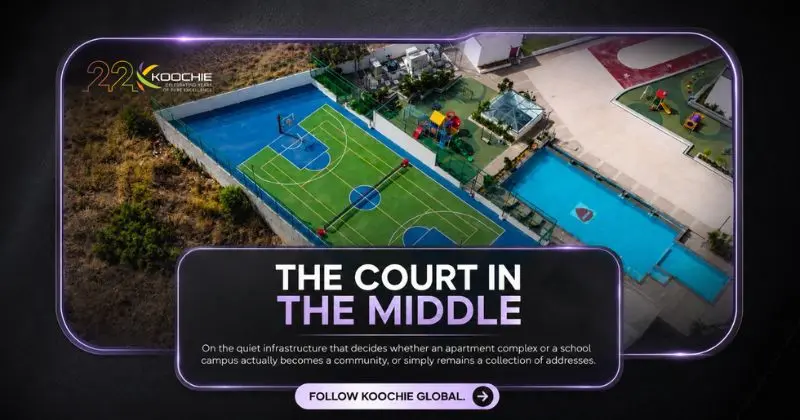
Why a Court Is Different From Every Other Amenity
Walk through any apartment complex built in the last fifteen years and you will likely pass a court of some kind. A half basketball hoop bolted to a wall. A patch of tiles marked out for badminton. Sometimes a proper multi use court with painted lines for three different sports layered on top of each other.
The quality of that space, and whether anyone actually uses it, tells you something about how the building was planned, and more quietly, about how the people inside it will come to know each other.
A court works differently from every other shared amenity in a residential complex. A clubhouse needs a booking. A gym needs equipment maintenance and often a membership fee buried somewhere in the maintenance bill. A swimming pool needs supervision and closes for half the year. A court needs almost nothing. A ball, two people, and enough light to see by.
This low barrier to entry is precisely why it becomes, over time, the place where a building’s actual social life happens. Children meet other children there before their parents ever exchange a word in the lobby. Teenagers claim it in the evening in a way they never claim the manicured garden downstairs. Retired residents walk its perimeter after dinner, sometimes stopping to watch a game they have no stake in, simply because it is the one place in the complex where something is always happening.
What a Court Means on a School Campus
Schools carry a different but related weight. A court on a school campus is not an amenity, it is curriculum. Physical education classes need it. Inter house competitions need it. The unstructured twenty minutes of recess, which research on child development keeps returning to as one of the more important parts of a school day, needs a surface that can survive several hundred children running across it every single day for nine months of the year. When that surface degrades, or was never built to the right specification in the first place, the twenty minutes shrinks. Children get sent to a classroom or a corridor instead, and something genuinely difficult to name, a certain kind of physical confidence that only develops through unstructured play, quietly does not develop.
Two Ways to Treat the Same Square Footage
What is striking is how differently this space gets treated depending on when and how a project was conceived. In some developments, the court is clearly an afterthought, a rectangle of leftover land near the boundary wall, surfaced with whatever material was cheapest at the time, unshaded, unlit after seven in the evening, and consequently empty for most of the day. In others, the same square footage has been treated as seriously as the lobby or the entrance facade. Proper drainage. A surface engineered to stay cool underfoot in peak summer. Lighting that extends its useful hours well into the evening, when working residents actually have time to use it. The difference in cost between these two approaches is smaller than most developers assume. The difference in how the space gets used, over a ten year period, is considerable.
A court that has been engineered properly tends to age into an asset. A court that was an afterthought tends to age into a visible reminder that it was one.
When It Goes Wrong
There is a particular kind of failure that shows up often enough to be worth naming directly. A court gets built, looks reasonable in the marketing brochure, and then within two or three years the surface has cracked, the paint has faded past recognition, or the equipment has quietly rusted into something nobody wants to touch. At that point, the space does not become empty. It becomes worse than empty. It becomes a visible signal, sitting in the middle of the complex, that maintenance was not thought through beyond the ribbon cutting. Residents notice this. It changes how they perceive everything else about the building, in a way that is disproportionate to the actual size or cost of the court itself.
What Happens When It's Built Right
The opposite is also true, and this is the quieter, more interesting part. A court that has been engineered properly tends to age in a way that becomes an asset rather than a liability. Three details tend to separate the two outcomes: a surface rated and certified for the load it will actually carry, drainage designed into the base rather than added as a fix, and a specification chosen for how it performs in year ten, not just how it photographs on handover day. This is the level of detail Koochie Global works to on every court it builds, whether the site is a residential complex or a school campus, because a certification on paper only means something if the surface still holds up to it a decade later.
Ten years in, a properly engineered court still gets used every evening. It still hosts the same informal cricket match every Sunday morning. New residents, touring the complex before deciding whether to buy or rent, notice that it is busy, and busy in a way that clearly is not staged. That single detail, more than almost any other amenity in a building, tends to correlate with how settled and how connected the existing community actually feels.
Schools that get this right tend to notice something similar, though it shows up differently. A properly built and properly maintained sports space becomes part of how the school markets itself to prospective parents, but more importantly, it becomes part of how the school actually functions. Fewer minor injuries from surfaces that were never designed to be run on at speed. Longer usable hours because the space does not become unbearably hot by mid morning. A wider range of sports and activities possible within the same footprint, because the surface and the layout were designed with multiple uses in mind from the outset, rather than retrofitted after the fact.
The Decision That's Actually Being Made
None of this needs a big budget. It needs one decision, made early, before the space has already failed. This is the work Koochie Global has done for over two decades. Not a product sold once.
Infrastructure built to still work, and still be used, ten years later. Next time you pass a court, notice if it’s being used. If it’s not, ask why. The answer is rarely about the sport. It’s almost always about a decision made long before anyone picked up a ball.