
How the wrong surfacing decision at the procurement stage leads to premature failure, higher replacement costs, and avoidable liability — and how to get it right the first time.
The Number That Looks Too Good
It starts with a procurement table. The premium safety surfacing option sits at one price. The budget alternative sits 35 to 40 percent below it. At handover, the two surfaces look identical. The colour is right, the texture is right, and the client has just saved roughly a third of the total surfacing budget. On paper, it is the rational choice.
But surfaces are not paper. Understanding what sits beneath that price difference is the first step toward making a specification decision that holds up over the actual life of the installation.
At Koochie, every surfacing project begins with a lifecycle assessment, not a unit cost comparison. Our specification process accounts for climate exposure, usage intensity, and certification compliance from the first conversation — because the right call at this stage determines everything that follows.
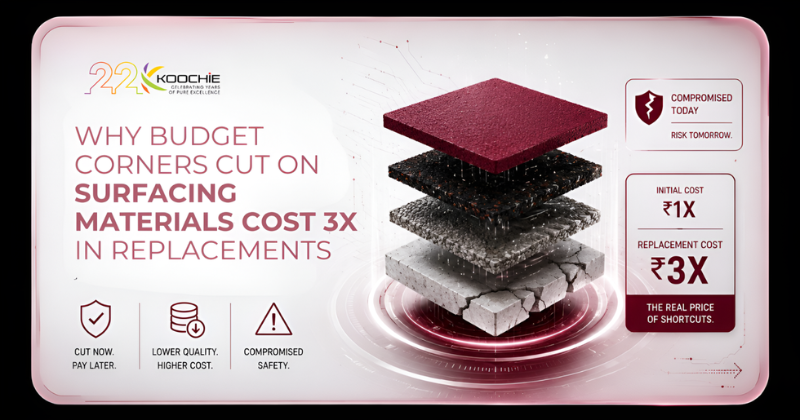
What Happens Beneath the Surface
Within the first twelve to eighteen months, UV exposure begins breaking down polymer binders inside cheaper surfacing materials. UV stabilisers are a cost adder, and they are often removed during formulation to hit a lower price point. Without them, the surface begins to change. Water retention increases because the drainage compound was not premium grade. Pockets form from uneven settling beneath the surface layer.
Here is what to look for:
- Surface becomes tacky in sustained heat and brittle when temperatures drop
- Drainage slows visibly after the second monsoon cycle
- Maintenance costs spike to 150–200% of what was originally budgeted
- Unplanned service calls become the new baseline spend
Koochie’s EPDM surfacing systems are formulated with UV-stabilised polymer binders and premium drainage compounds as standard. These are not upgrades. They are built into the base specification because we have seen what happens when they are not.
Year Three: When the Real Cost Arrives
By the third year, a budget surface typically falls below impact attenuation standards. EN 1177 compliance slips. This is not cosmetic — it is a liability issue. If a child is injured on a surface that has fallen below certification thresholds, the site owner is defending a known degraded surface, not an accident on a compliant one.
At this point, replacement follows a predictable sequence:
- Full removal and disposal adds 15–20% on top of the replacement cost
- New installation goes in at full premium price — there is no budget option the second time
- Court or playground offline for 4–6 weeks during the work
- Residential societies face access loss and resident complaints; commercial sites face revenue loss
The Lifecycle Arithmetic
When the total cost is tallied over a five-year window, the budget path consistently costs 180 to 220 percent of what the premium path would have cost. The premium path spreads its investment over eight to ten years of reliable, certified performance with minimal unplanned maintenance.
The Costs That Do Not Appear on Any Invoice
Beyond the replacement cost itself, four other costs compound when a surface degrades prematurely:
- Certification drift
- Insurance ambiguity
- Contractor disputes
- Reputation damage
Why Material Composition Matters More Than Price
Material composition creates a 300 to 500 percent performance gap over the lifecycle of a safety surface.
Getting It Right from Day One
The shift happens when the conversation moves from unit cost to cost per year of reliable use. A premium surface, spread over ten or more years of certified performance, costs a fraction per year of what the budget surface costs when its replacement cycle is factored in.
Getting It Right from Day One
The shift happens when the conversation moves from unit cost to cost per year of reliable use. A premium surface, spread over ten or more years of certified performance, costs a fraction per year of what the budget surface costs when its replacement cycle is factored in.